Why Some Big Bus Operators in Kenya Are SACCOs While Others Operate Independently

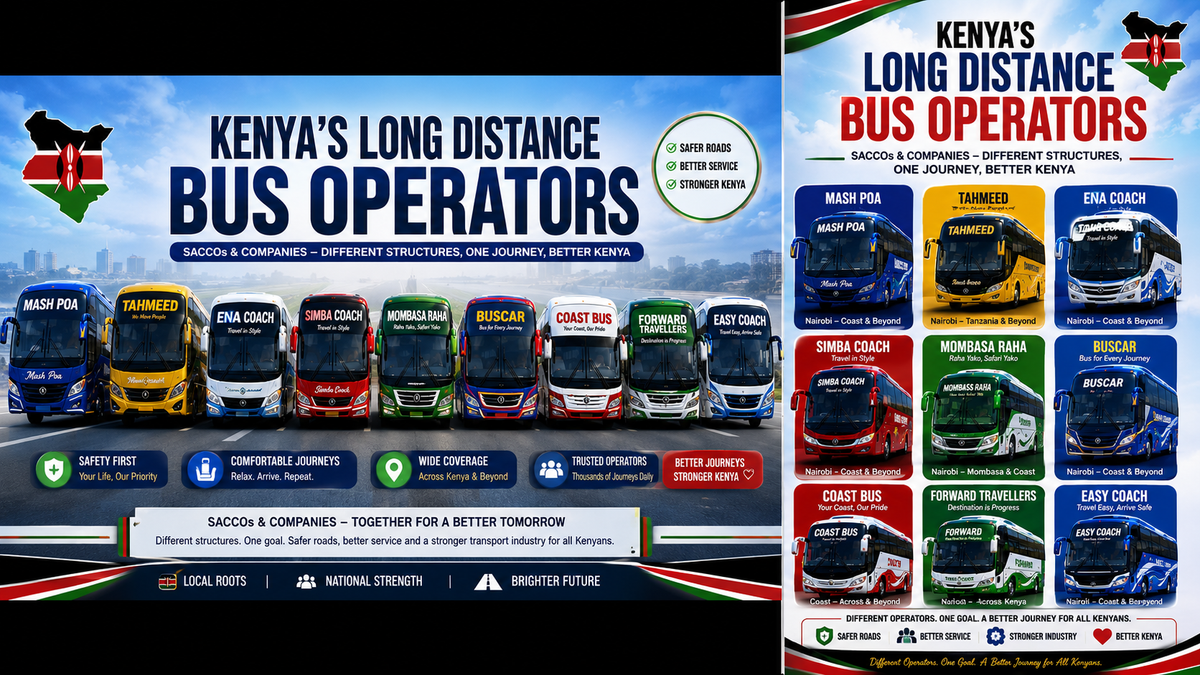
The surprising structure behind Kenya's long-distance bus industry
When Kenyans talk about long-distance buses, names such as Mash Poa, Tahmeed, Simba Coach, Mombasa Raha, Buscar, Coast Bus and Easy Coach often dominate the conversation.
To passengers, they all look similar.
They have:
- Branded buses
- Booking offices
- Scheduled departures
- Drivers and conductors
- Long-distance routes
- Online or office-based ticketing
- Large passenger networks
But behind the branding, these operators may have very different legal and business structures.
Some may operate through an independent company.
Others may operate through a SACCO.
Some bus brands may even operate under a SACCO whose name is completely different from the name passengers see on the bus.
That is where the story becomes interesting.
First, what does the law actually require?
A common misconception is:
“Every public service bus must belong to a SACCO.”
That is not the correct way to understand Kenya's PSV regulatory framework.
The National Transport and Safety Authority (Operation of Public Service Vehicles) Regulations, 2014 apply to public service vehicles operating on Kenyan roads. The regulations require a person seeking to operate PSVs to be a member of a qualifying body corporate.
The regulations define a corporate body to include:
- A limited liability company
- A cooperative society
- A society registered under the Societies Act
The regulations also state that the body corporate must have a minimum of 30 serviceable vehicles registered as PSVs, or vehicles for which an application for a licence has been or is to be lodged with the Authority, under the relevant conditions.
The regulations further require operators to display the name of the “Sacco or company” under which the vehicle operates.
That wording is extremely important.
It shows that the legal framework recognises two broad operating structures:
SACCO
or
Company
The law therefore does not require every large bus operator to be a SACCO.
A qualifying company can operate independently.
A qualifying cooperative can operate as a SACCO.
The key issue is regulatory compliance, fleet capacity and operational responsibility.
The 30-vehicle minimum: what does it really mean?
The 30-vehicle requirement is one of the most important parts of the PSV framework.
In simple terms, an operator seeking to operate under the applicable corporate PSV structure must have a substantial fleet.
This means a person cannot simply purchase one bus and automatically create a large independent PSV operating organisation under the same framework as a major bus operator.
The requirement is designed to ensure that the operator has sufficient organisational capacity.
A body corporate also needs the appropriate management and operational structures, including requirements relating to:
- Drivers
- Route inspectors
- Office management
- Accounts
- Mechanical support
- Employee management
- Safety management
- Customer complaints
- Regulatory compliance
The regulation therefore treats PSV operation as more than simply owning a bus.
A large public transport operation requires an organisation behind the vehicle.
The two main models
Model One: The SACCO model
The SACCO model generally brings together multiple vehicle owners or members under one cooperative organisation.
The structure may look like this:
Vehicle owners → SACCO → common operating system
The SACCO may provide:
- Common branding
- Route management
- Compliance systems
- Vehicle administration
- Driver coordination
- Member management
- Safety systems
- Operational oversight
In this model, the vehicles may be owned by different members, while the SACCO provides the organisation through which they operate.
This is common in the matatu industry.
However, SACCOs are not limited to small 14-seater matatus.
A SACCO can become a very large transport organisation.
Forward Travellers proves that a SACCO can become a giant transport operator
A good example is Forward Travellers SACCO.
According to Isuzu East Africa, Forward Travellers SACCO operated a fleet of approximately 450 buses in 2024, including 260 Isuzu units. The SACCO served numerous routes and had hundreds of licensed drivers.
This is important because it destroys the common assumption that:
“SACCOs are only for small matatus.”
A SACCO can operate a fleet larger than many companies.
The difference is not necessarily the number of vehicles.
The difference is the ownership and organisational structure.
Forward Travellers demonstrates that a SACCO can be:
- Large
- Professionally managed
- Fleet-based
- Route-oriented
- Technology-enabled
- Commercially sophisticated
In other words, the word SACCO does not automatically mean a small or informal transport organisation.
Model Two: The independent company model
The second model is the independent corporate bus company.
The structure may look like this:
Company → owns or controls fleet → manages operations → operates under its own brand
In this model, one company may:
- Own buses
- Lease buses
- Finance buses
- Employ drivers
- Employ conductors
- Operate booking offices
- Manage routes
- Maintain workshops
- Manage customer service
- Control branding
The company is not required to join another SACCO simply because it operates public service vehicles.
If the company satisfies the applicable regulatory requirements, it can operate independently.
This is the model many people associate with large national and regional bus brands.
Why large bus companies may prefer operating independently
A large independent bus company can have centralised control over its entire business.
For example, management can decide:
- Which bus operates on which route
- Which bus is undergoing maintenance
- When a vehicle should be replaced
- How drivers are scheduled
- How tickets are sold
- How customer complaints are handled
- How the brand is marketed
The entire operation can be managed as one corporate organisation.
This is especially useful for long-distance travel.
A bus travelling from Mombasa to Nairobi or from Nairobi to another region may require more centralised planning than a local commuter vehicle.
The company may need to coordinate:
- Departure schedules
- Long-distance driver shifts
- Fuel
- Maintenance
- Passenger reservations
- Parcel services
- Vehicle inspections
- Route compliance
A corporate structure can make such decisions easier to centralise.
So where do Mash Poa and Tahmeed fit?
Large brands such as Mash Poa and Tahmeed are good examples of why passengers should distinguish between a public brand and a legal operating structure.
Passengers see the brand on the bus.
However, the legal entity operating the bus may be:
- The same company as the brand
- A subsidiary
- A company operating through a contract
- A franchise arrangement
- A SACCO structure
- Another approved corporate arrangement
The name printed on the side of a bus does not, by itself, tell the whole legal story.
That is why the question:
“Is this bus a SACCO or a company?”
cannot always be answered simply by looking at the bus branding.
The actual operating entity and licensing arrangement are what matter.
Buscar: an important example of the SACCO model
Buscar is one of the clearest examples of a major long-distance transport organisation operating through a SACCO structure.
The organisation is publicly referred to as Buscar SACCO.
What makes Buscar particularly interesting is that it demonstrates how a SACCO can operate at a scale associated with major commercial bus companies.
The public image of a SACCO is often associated with local matatus.
Buscar shows that the SACCO structure can also support:
- Long-distance routes
- Large buses
- Professional branding
- Centralised booking
- Fleet operations
- Regional transport
This is an important reminder that a SACCO is not automatically a small organisation.
Coast Bus and Buscar: when a bus brand joins an existing SACCO
One of the most interesting examples is Coast Bus.
In 2024, public reports stated that Coast Bus joined Buscar SACCO in a move linked to compliance with the minimum fleet requirement. The reporting said that the arrangement allowed Coast Bus to operate within a larger SACCO structure.
This creates an important distinction:
Brand: Coast Bus
Operating SACCO connection: Buscar SACCO
This does not necessarily mean that the Coast Bus brand disappears.
It demonstrates that:
A bus brand and the SACCO under which it operates do not always have to carry the same name.
This is a crucial point for understanding the Kenyan transport industry.
A passenger may see one brand on the bus while the regulatory and organisational structure behind the operation may be another entity.
This is why “brand” and “operator” should not be confused
Imagine seeing a bus branded:
COAST BUS
The passenger naturally assumes:
“The company on the bus must be the legal operator.”
But in the transport industry, several different entities may be involved:
The brand
The name passengers recognise.
The vehicle owner
The individual or company that legally owns the bus.
The operator
The entity with operational responsibility.
The SACCO or company
The corporate structure under which the vehicle operates.
The booking agent
The organisation selling the ticket.
These may all be the same entity.
But they do not always have to be.
That is why a bus brand can operate under a SACCO with a different name.
The difference between ownership and operation
This is another area that causes confusion.
A bus may be owned by:
- A company
- An individual
- A financing institution
- A cooperative member
But the vehicle may operate under:
- A SACCO
- A company
- A contractual arrangement
- An approved operating structure
The regulations define an operator as the corporate body with operational responsibility over the PSV, either as the registered owner or through a contract or franchise arrangement with the registered owner.
This means the person who owns the vehicle and the organisation responsible for operating it may not always be exactly the same.
That is why the legal operating structure can be more complicated than the logo on the side of the bus.
Why would a bus company join a SACCO?
A smaller bus operator may face a problem.
Suppose the operator has:
- 5 buses
- 10 buses
- 15 buses
- 20 buses
But the applicable regulatory requirement is based on a minimum fleet of 30 vehicles for the body corporate.
The operator may then have several options:
Option 1: Grow its own fleet
The operator can build a fleet that satisfies the requirement.
Option 2: Establish a qualifying corporate structure
The operator can create and operate through an appropriate company or cooperative structure that meets the regulatory requirements.
Option 3: Join an existing SACCO
The operator can become part of an existing SACCO that already has the required organisational and fleet capacity.
The publicly reported Coast Bus-Buscar arrangement illustrates why this third option can be attractive.
Why do some large bus companies not join SACCOs?
A company that already has a sufficiently large fleet may not need to join another SACCO.
It can simply operate independently if it meets the legal and regulatory requirements.
This gives the company:
Direct control
Management controls the fleet and operations.
Independent branding
The company develops its own brand.
Centralised finances
Revenue, expenses and investment are managed through the company.
Direct expansion
The company can purchase more buses and expand routes.
Corporate investment
The business can potentially raise financing or attract investors through its corporate structure.
For a large operator, joining another SACCO may therefore provide little advantage if the company already has the capacity to operate independently.
But a SACCO can also become extremely large
This is where the common assumption breaks down.
People sometimes imagine the industry as:
Small buses = SACCO
Big buses = company
But Forward Travellers shows that this is not necessarily true.
A SACCO can have hundreds of buses.
A company can have a small fleet.
The size of the bus does not determine the legal structure.
The number of buses alone does not determine whether the operator is a SACCO.
The important question is:
What legal entity has operational responsibility for the vehicles?
Examples of the different structures
Based on publicly available information, the industry can be understood broadly as follows:
| Operator or brand | SACCO connection | What the public information shows |
|---|---|---|
| Buscar | Clear SACCO structure | Publicly associated with Buscar SACCO |
| Coast Bus | Reported connection to Buscar SACCO | Reported to have joined Buscar SACCO in 2024 |
| Forward Travellers | Clear SACCO structure | Reported by Isuzu East Africa as operating a 450-bus SACCO fleet |
| Mash Poa | Requires confirmation of current legal operating structure | Major branded long-distance operator |
| Tahmeed | Requires confirmation of current legal operating structure | Major branded regional operator |
| Simba Coach | Requires confirmation of current legal operating structure | Major branded bus operator |
| Mombasa Raha | Requires confirmation of current legal operating structure | Branded bus operator |
| Easy Coach | Requires confirmation of current legal operating structure | Major branded bus operator |
The important caution is that a brand name alone is not sufficient evidence of whether an operator is legally a SACCO or a company.
The current licence holder and operating entity should be confirmed through current official records.
The 30-vehicle requirement is not a “SACCO-only” requirement
This point deserves special emphasis.
The popular explanation is often:
“You need 30 vehicles to form a SACCO.”
That explanation is incomplete.
The regulatory framework refers to a corporate body and recognises a limited company, cooperative society or society within the relevant definition.
It also expressly refers to the Sacco or company under which the vehicle operates.
Therefore, the regulatory framework is not simply saying:
“Every operator must be a SACCO with 30 vehicles.”
Rather, the framework establishes requirements for the corporate body responsible for the PSV operation.
The important legal distinction is:
SACCO is one organisational structure.
Company is another organisational structure.
Both can be used within the regulatory framework, subject to applicable requirements.
A simple illustration
Independent company model
Company Ltd
↓ owns or controls
30+ buses
↓
Operates under its own brand
↓
Manages:
- Drivers
- Routes
- Booking
- Maintenance
- Safety
- Customers
SACCO model
Many vehicle owners or members
↓
SACCO
↓
Common operating system
↓
Manages:
- Routes
- Compliance
- Branding
- Fleet administration
- Drivers
- Safety
Brand operating under another SACCO
Coast Bus brand
↓
Vehicles and operation
↓
Buscar SACCO structure
↓
Regulatory and operational framework
This third model is the one that makes the industry particularly interesting.
Does a SACCO automatically mean better service?
No.
The legal structure alone does not guarantee quality.
A company can be poorly managed.
A SACCO can be professionally managed.
A SACCO can also have hundreds of buses and sophisticated operations.
The things that ultimately matter include:
- Vehicle safety
- Maintenance
- Driver competence
- Compliance
- Management systems
- Customer service
- Financial controls
- Accountability
The PSV regulations themselves place significant emphasis on operational systems, including vehicle inspections, safety management, employee requirements and customer complaint handling.
The bigger lesson from Kenya's bus industry
The Kenyan bus industry is more sophisticated than the simple assumption that:
“Big bus = company.”
The reality is more layered.
A major transport operation can be:
- A company
- A SACCO
- A bus brand operating through a SACCO
- A company controlling its own fleet
- A corporate operator using vehicles owned by other entities
The passenger sees the bus.
The regulator sees the operating entity.
The owner sees the asset.
The SACCO or company manages the operation.
These are not always the same thing.
Final takeaway
The reason some large bus operators in Kenya are not SACCOs is simple:
The law allows a qualifying company to operate public service vehicles independently.
The reason some other bus operators are SACCOs is equally simple:
A SACCO is also a recognised organisational structure for public transport operations.
The 30-vehicle minimum is therefore a critical fleet and corporate capacity requirement, but it should not be interpreted as meaning that every large bus operator must join a SACCO.
The Kenyan PSV industry contains both models.
On one side, there are independent corporate operators that can build and manage their own fleets.
On the other side, there are SACCOs that have grown into enormous transport organisations.
Forward Travellers SACCO, with a reported fleet of approximately 450 buses, demonstrates that a SACCO can become a major professional transport operator.
Buscar demonstrates the long-distance bus SACCO model, while the reported Coast Bus-Buscar arrangement demonstrates that a recognised bus brand can operate within a larger SACCO structure.
And this is the key lesson:
The name on the bus is not always the name of the legal operator.
A bus can carry one brand, be owned by one entity and operate under another SACCO or company structure.
That is why Kenya's long-distance bus industry is not simply a battle between “companies” and “SACCOs.”
It is a mixture of corporate ownership, cooperative structures, fleet management and passenger-facing brands, all operating within a regulated public transport system. 🚍