Why Does Saudi Arabia Have No Permanent Rivers?

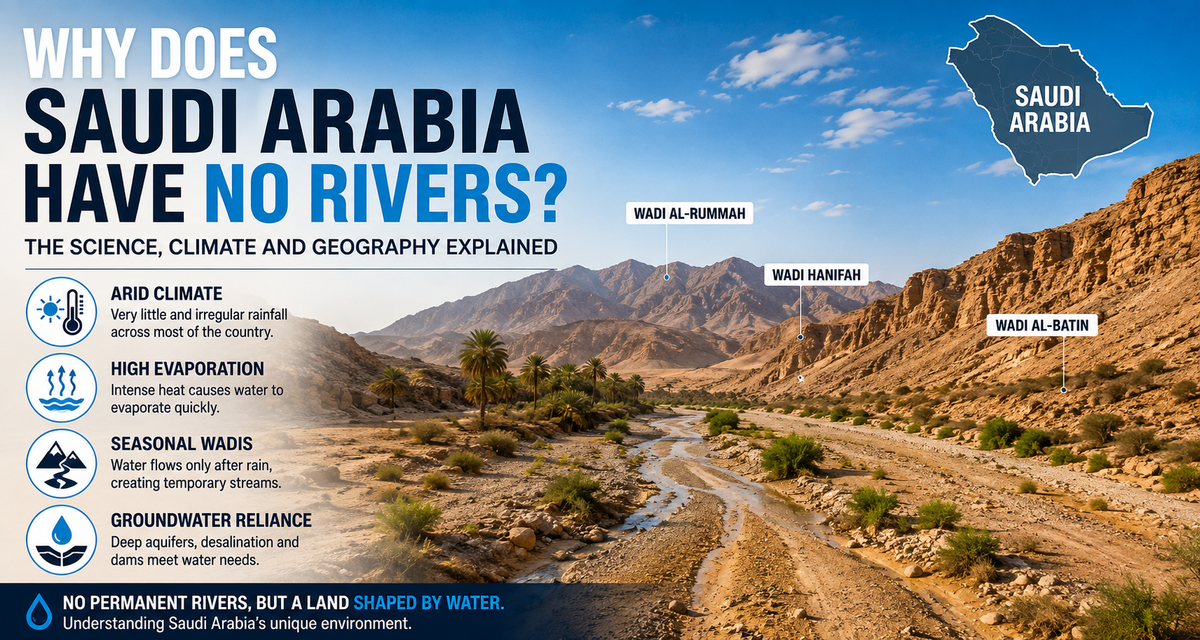
Saudi Arabia is one of the world's most geographically remarkable countries. Covering most of the Arabian Peninsula, it has vast deserts, mountain ranges, coastal plains and enormous underground water reserves. Yet there is one feature that immediately stands out on a physical map: Saudi Arabia has no permanent natural rivers.
This does not mean that water never flows across the country. Saudi Arabia has hundreds of wadis—natural valleys and drainage channels that can carry substantial amounts of water after rainfall. The difference is that these watercourses generally do not maintain a continuous flow throughout the year. (Saudipedia)
So, why doesn't Saudi Arabia have a river like the Nile, Congo or Tigris?
1. Saudi Arabia is predominantly a desert country
The fundamental reason is climate.
Much of Saudi Arabia has an arid or semi-arid climate characterized by very limited and irregular rainfall. The country's vast interior receives particularly little precipitation, while the southwestern highlands receive considerably more. (Saudipedia)
For a permanent river to exist, there needs to be a relatively reliable source of water feeding the river system. This usually comes from:
- Regular rainfall
- Snowmelt
- Glaciers
- Large lakes
- Persistent groundwater discharge
Saudi Arabia does not have these conditions on a scale sufficient to sustain a large, year-round river system.
According to Saudi government information, rainfall is scarce and a significant portion of the rainwater is lost through intense evaporation. Some water infiltrates the ground, while another portion temporarily flows through valleys. (Saudipedia)
2. Extremely high evaporation removes water quickly
Saudi Arabia's climate is not simply dry—it is also characterized by high temperatures and strong evaporation.
When rain falls on the desert, several things can happen:
Rain → surface runoff → wadi → evaporation/infiltration
Instead of remaining in a channel long enough to create a permanent river, much of the water either:
- evaporates,
- infiltrates into the ground,
- collects temporarily in low-lying areas, or
- flows toward the Red Sea or Arabian Gulf.
This is one of the major reasons that a wadi can be completely dry for months or years and then suddenly become a powerful torrent following heavy rainfall.
3. Saudi Arabia does receive rain—but irregularly
It would be incorrect to say that Saudi Arabia has no rainfall.
Some regions receive significantly more rainfall than others. The Hejaz and Sarawat mountain ranges in the west and southwest influence rainfall patterns, while the Aseer highlands are among the wetter areas of the Kingdom. (Saudipedia)
The problem is seasonality and variability.
A region may receive intense rainfall during a short period, followed by a prolonged dry period. This creates flash floods and temporary streams rather than permanent rivers.
That explains a fascinating phenomenon in Saudi Arabia: a completely dry valley can suddenly carry enormous quantities of water.
4. Saudi Arabia's wadis are ancient river systems
One of the most interesting parts of the story is that Saudi Arabia has not always looked the way it does today.
During earlier, wetter climatic periods, parts of the Arabian Peninsula experienced substantially different environmental conditions. Geological evidence shows that major drainage systems existed across parts of what is now Saudi Arabia.
Saudi geological information identifies ancient drainage systems associated with areas such as:
- Wadi Al-Rummah–Al-Batin
- Wadi Hanifah–Al-Sahba
- Wadi Al-Dawasir
These ancient systems transported sediment from elevated western areas toward the east. (Saudipedia)
In other words, some of today's enormous dry valleys are effectively remnants of a much wetter geological past.
5. What exactly is a wadi?
A wadi is a valley, channel or drainage system that is usually dry but can carry water after rainfall.
Saudi Arabia has hundreds of these seasonal watercourses. They occur throughout much of the country, although their distribution varies significantly by region. (Saudipedia)
Some are extremely large.
Wadi Al-Rummah
Wadi Al-Rummah is one of the most significant drainage systems in the Arabian Peninsula. Saudi sources describe it as extending for roughly 510 km and passing through areas including Hail and Qassim. (Saudipedia)
Despite its impressive size, it is not equivalent to a permanent river because its flow is not sustained continuously throughout the year.
Wadi Bishah
Wadi Bishah in Aseer is another major valley, extending for approximately 460 km. It is associated with the King Fahd Dam and forms part of an important regional drainage system. (Saudipedia)
Wadi Hanifah
Wadi Hanifah is particularly important because it passes through the Riyadh region and has historically supported settlements and agriculture. (Saudipedia)
6. Mountains create runoff—but not permanent rivers
Saudi Arabia's western and southwestern mountains provide an important source of surface runoff.
When rainfall falls on elevated terrain, gravity causes water to flow downhill. The water cuts channels through the landscape and eventually forms wadis.
The general process is:
Mountain rainfall
↓
Rapid surface runoff
↓
Streams and tributaries
↓
Wadi
↓
Red Sea / Arabian Gulf / inland basin
↓
Water disappears through evaporation, infiltration or discharge
Some valleys have external drainage and eventually reach the Red Sea or Arabian Gulf, while others have internal drainage, meaning their water terminates within inland depressions rather than reaching the sea. (Saudipedia)
7. Why doesn't groundwater create permanent rivers?
This is an important question.
Saudi Arabia actually possesses enormous groundwater reserves. Some aquifers contain water accumulated over very long geological periods.
But groundwater does not automatically produce rivers.
For a groundwater-fed river to remain permanent, groundwater must continuously emerge at the surface through springs or sustained baseflow. In much of Saudi Arabia, groundwater is instead stored underground within geological formations.
Saudi Arabia therefore relies heavily on:
- Deep groundwater
- Renewable groundwater in some areas
- Surface water
- Desalinated seawater
- Treated wastewater
- Rainwater captured by dams and other infrastructure. (Saudipedia)
Some groundwater reserves are effectively fossil water—water stored underground over extremely long periods and replenished very slowly.
8. The Empty Quarter is an extreme example
The Rub' al Khali, or Empty Quarter, occupies a huge area of southern Saudi Arabia and is one of the world's largest continuous sand deserts.
It represents perhaps the clearest example of the country's extremely dry environment.
Saudi geographical information indicates that seasonal watercourses become extremely scarce and are essentially absent in the Empty Quarter. (Saudipedia)
The combination of:
- very low rainfall,
- high evaporation,
- enormous sand dunes,
- limited surface drainage,
makes permanent surface water extremely difficult to maintain.
9. But Saudi Arabia can still experience major floods
The absence of permanent rivers does not mean Saudi Arabia is immune to flooding.
Quite the opposite.
Heavy rainfall can produce flash floods because large quantities of water can suddenly run off mountains and hardened surfaces into narrow wadis.
This creates a seemingly contradictory situation:
A country can have no permanent rivers yet experience dangerous river-like floods.
A dry wadi can change dramatically within hours following intense rainfall.
This is why construction and urban development around wadi channels requires careful flood management.
10. Saudi Arabia's relationship with water is unusual
The lack of permanent rivers has had enormous consequences for settlement, agriculture and economic development.
Historically, communities depended on:
- Wells
- Springs
- Oases
- Seasonal wadis
- Groundwater
Modern Saudi Arabia has supplemented these natural resources with large-scale seawater desalination, water storage infrastructure and wastewater treatment.
This is particularly important because the country has large cities and agricultural areas despite its naturally limited surface-water resources.
11. Does Saudi Arabia have any rivers?
The technically correct answer is:
Saudi Arabia has no permanent natural rivers within its territory.
However, it has numerous seasonal watercourses and wadis, and some valleys can carry substantial flows following rainfall. (Saudipedia)
This distinction is important.
| Feature | Permanent river | Saudi wadi |
|---|---|---|
| Water flow | Generally continuous | Usually seasonal |
| Main water source | Rain, snowmelt, groundwater, lakes | Mainly rainfall/runoff |
| Flow duration | Year-round | Hours, days or occasionally longer |
| Dry periods | Usually limited | Common |
| Flood risk | Exists | Can be very high during storms |
| Examples | Nile, Congo, Amazon | Wadi Al-Rummah, Wadi Hanifah, Wadi Bishah |
12. Could Saudi Arabia ever develop a permanent river naturally?
Under today's climate, the development of a major natural permanent river across Saudi Arabia would be extremely unlikely.
It would require a fundamental change in the region's hydrological balance—particularly substantially greater and more reliable precipitation or another persistent water source.
Climate change could alter rainfall patterns, but that does not mean Saudi Arabia will naturally develop rivers. In fact, changes in temperature and precipitation could make water management even more challenging.
A canal or artificial waterway could certainly be constructed, but that would be fundamentally different from a natural river.
The bigger geographical story
Saudi Arabia's lack of permanent rivers is not an accident. It is the result of the interaction between climate, topography, geology and hydrology.
The country receives insufficient and irregular rainfall to maintain major permanent surface-water systems. High temperatures promote rapid evaporation, while much of the rainfall that does reach the ground either infiltrates into geological formations or rapidly runs off through valleys.
Over thousands and millions of years, wetter climatic periods carved extensive drainage networks. Today, many of these remain as enormous wadis—evidence that the Arabian Peninsula's climate has changed dramatically through geological time. (Saudipedia)
So when looking at a map of Saudi Arabia and seeing no blue lines representing permanent rivers, the correct conclusion is not that "Saudi Arabia has no water."
It is that Saudi Arabia's water is distributed differently.
Some is underground. Some arrives unpredictably as rain. Some rushes temporarily through wadis. Some is stored behind dams. And a significant proportion of modern urban water comes from the sea through desalination.
That makes Saudi Arabia one of the world's most interesting examples of how human civilization can develop in a landscape where permanent rivers are absent.
Key takeaway
Saudi Arabia has no permanent natural rivers primarily because its arid climate provides too little reliable rainfall to sustain continuous surface flow. High evaporation, rapid infiltration, internal drainage and the country's desert geography further prevent rivers from maintaining year-round flow. Instead, the Kingdom has hundreds of seasonal wadis, many of which are remnants of ancient drainage systems formed during wetter climatic periods. (Saudipedia)