Why Big Bus Companies Like Mash Poa, Tahmeed, Simba Coach, Mombasa Raha and Buscar Are Not SACCOs

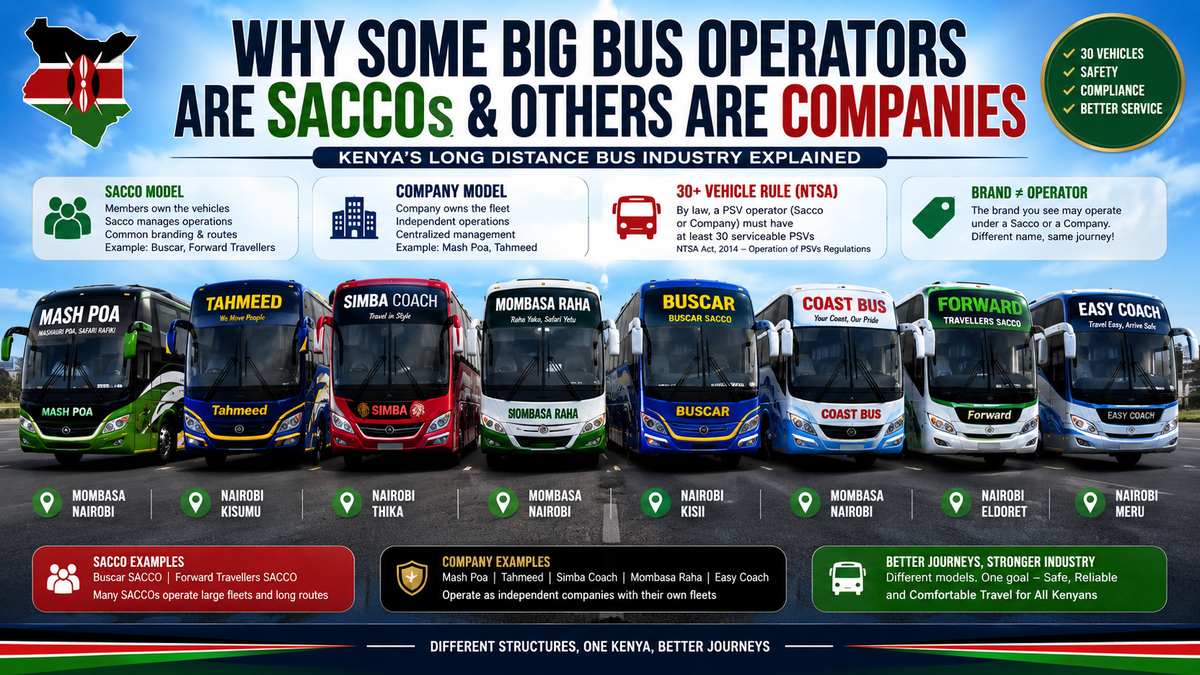
The difference between a SACCO and an independent bus company in Kenya
When Kenyans discuss long-distance bus travel, names such as Mash Poa, Tahmeed, Simba Coach, Mombasa Raha and Buscar immediately come to mind.
These operators run scheduled routes, operate large fleets, maintain booking offices and online ticketing systems, employ drivers and conductors, and serve thousands of passengers travelling across Kenya and the wider East African region.
But an interesting question often arises:
If a public service vehicle operator needs a sizeable fleet, why are these big bus companies not operating under a SACCO?
The answer is found in the structure of Kenya's public transport regulations and the difference between a SACCO model and an independent corporate bus company.
What is a SACCO in public transport?
A SACCO, or Savings and Credit Cooperative Society, is a cooperative organisation owned and controlled by its members.
In the PSV sector, the SACCO model has historically allowed individual vehicle owners or operators to come together under one organisation. The SACCO may then provide a common operating structure, including:
- Route management
- Vehicle administration
- Driver and conductor coordination
- Compliance systems
- Revenue and operational management
- Common branding
- Fleet administration
The individual vehicles may belong to different members, but they operate under the SACCO's approved structure.
This is why many matatu operators operate under SACCOs.
However, a SACCO is not the only possible structure for operating public service vehicles in Kenya.
The law does not require every large bus operator to be a SACCO
One of the most important points is that Kenyan PSV regulations recognise different types of operating entities.
The regulations allow a public service vehicle operation to be organised through structures such as a company or a SACCO.
The distinction is therefore not:
SACCO = legal operator
Company = illegal operator
Instead, the real question is whether the entity satisfies the applicable regulatory, safety, licensing and operational requirements.
The Operation of Public Service Vehicles Regulations, 2014 provides for a body corporate seeking to operate public service vehicles to meet fleet and other regulatory requirements. A key requirement is the minimum fleet threshold of 30 serviceable public service vehicles, or vehicles for which licensing applications have been made, under the applicable regulatory framework.
This is the basis of the idea that an independent operator seeking to operate at a significant scale must have a substantial fleet.
The important point is that the 30-vehicle requirement does not automatically mean that the operator must be a SACCO.
A company can independently meet the fleet requirement and operate its own buses.
That is the fundamental difference.
The two major models
Model 1: The SACCO model
The structure may look like this:
Many vehicle owners → SACCO → common transport operation
For example:
- Member A owns a bus
- Member B owns a bus
- Member C owns a bus
- Other members also own vehicles
They come together under a cooperative organisation.
The SACCO provides the common operating framework.
The SACCO may control:
- Route operations
- Compliance
- Scheduling
- Branding
- Membership
- Vehicle documentation
- Safety procedures
The SACCO model is therefore useful where many independent vehicle owners want to operate collectively.
Model 2: The independent company model
The structure may instead look like this:
Company → owns or controls fleet → employs staff → operates routes
In this model, one corporate organisation may:
- Own buses
- Lease buses
- Finance buses
- Manage fleet operations
- Employ drivers
- Employ conductors
- Operate booking offices
- Maintain workshops
- Manage customer service
- Develop its own brand
This is the model commonly associated with large intercity bus operators.
The company does not need to join a SACCO simply because it operates public service vehicles.
If the company itself meets the regulatory requirements, it can operate as an independent corporate operator.
Why companies such as Mash Poa can operate independently
Mash Poa illustrates the corporate bus operator model.
Its publicly available booking information presents it as an intercity bus operator serving routes across Kenya and the wider East African region. Its services include routes such as Nairobi–Mombasa and other major intercity connections, with different classes of service and a centralised booking operation.
This is fundamentally different from a SACCO consisting of numerous independent vehicle owners.
The company model allows the operator to centralise decisions such as:
- Which buses operate on which routes
- When buses depart
- Which vehicle is assigned to a particular trip
- Fleet maintenance
- Customer service
- Ticketing
- Branding
- Staff management
Instead of dozens of independent owners making separate decisions, the company can operate through a central management structure.
That is particularly important for long-distance transport.
Tahmeed: another example of the large-operator model
Tahmeed is another well-known name in East African intercity bus transport.
Publicly available information about its bus services describes long-distance routes, modern coaches, onboard amenities, professional drivers, customer support and cross-border operations.
A large intercity operator needs a very different management system from a small local PSV operation.
Imagine coordinating:
- Multiple departures every day
- Long-distance routes
- Driver shifts
- Vehicle inspections
- Maintenance
- Passenger bookings
- Parcel services
- Cross-border operations
- Customer complaints
- Route scheduling
A central corporate structure can make these decisions much easier.
This is one of the reasons why large operators tend to operate as companies rather than as traditional SACCOs.
Simba Coach, Mombasa Raha and Buscar
The same general principle applies to operators such as Simba Coach, Mombasa Raha and Buscar.
The public generally sees the bus brand.
Passengers usually do not ask:
Who owns every individual bus?
Instead, they interact with:
- The company brand
- Booking offices
- Ticketing systems
- Customer service
- Bus schedules
- Route networks
This is the major difference between a traditional member-based SACCO and a large branded intercity operator.
A SACCO may bring together numerous vehicle owners.
A large bus company may instead build a single operational organisation around its own fleet and brand.
Why the 30-vehicle threshold is important
The 30-vehicle requirement is important because it helps separate a large independent operator from a small individual PSV operation.
A person with one bus cannot simply operate at the same level as a major nationwide intercity bus company.
The regulatory framework requires a sufficiently substantial operation for certain corporate PSV arrangements.
This means a company that wants to operate independently must have the capacity to manage a sizeable fleet and comply with the relevant requirements.
In simple terms:
A large company can operate independently, but it must meet the applicable regulatory conditions.
The requirement is therefore about the operator's legal and operational capacity, not simply whether it belongs to a SACCO.
Why large bus companies may prefer the company model
1. Centralised control
A company can make decisions from one central management structure.
For example, management can decide:
- Bus A operates Nairobi–Mombasa
- Bus B operates Nairobi–Kisumu
- Bus C undergoes maintenance
- Bus D replaces a vehicle that has developed a mechanical problem
This can be much easier when the buses are controlled centrally.
2. Stronger brand identity
Companies such as Mash Poa and other major operators build their own brands.
Passengers recognise:
- The name
- The colours
- The buses
- The booking offices
- The customer experience
A company can invest heavily in a single brand.
This is valuable in a competitive transport industry.
3. Easier investment and financing
A corporate structure can make it easier to:
- Raise investment
- Obtain asset financing
- Purchase new buses
- Enter partnerships
- Expand to new routes
A growing bus company may need to invest millions of shillings in vehicles, offices, technology and maintenance infrastructure.
A corporate structure can be more suitable for this type of expansion.
4. Professional fleet management
Long-distance buses are expensive assets.
They require:
- Preventive maintenance
- Tyre management
- Insurance
- Inspection
- Fuel management
- Driver monitoring
- Accident response
- Replacement planning
A large company can create a dedicated fleet management department.
5. Better integration of technology
Modern bus companies increasingly use:
- Online booking
- Mobile payments
- Digital ticketing
- Customer databases
- Fleet tracking
- Automated scheduling
The corporate model can make it easier to invest in and integrate these systems.
Does being a SACCO automatically mean better operations?
No.
The legal structure alone does not guarantee good or bad service.
A company can have poor management.
A SACCO can have excellent management.
The most important issues are:
- Safety
- Vehicle maintenance
- Driver competence
- Regulatory compliance
- Financial management
- Customer service
- Management accountability
The recent regulatory environment demonstrates why management and operational control matter.
For example, the National Transport and Safety Authority has taken enforcement action against PSV operators where serious safety and compliance deficiencies were identified. In June 2026, NTSA announced the revocation of the operator licence of Nicco Movers 1 Sacco, citing significant safety and compliance concerns and a loss of control over fleet operations.
This is an important lesson:
The name “SACCO” or “company” does not itself guarantee safety. The quality of management and compliance is what matters.
Why the model works differently for long-distance buses
Long-distance buses are not exactly the same as ordinary urban matatus.
A major intercity operator may have to coordinate:
- Fixed departure times
- Long-distance driver scheduling
- Multiple terminals
- Passenger reservations
- Route planning
- Rest and maintenance schedules
- Cross-border documentation
- Parcel operations
- Customer service
This creates a strong need for centralised control.
If every vehicle owner independently made decisions about routes, schedules and operations, maintaining a consistent national brand would become more complicated.
That is why the company model can be attractive to large intercity operators.
A simple comparison
| Feature | SACCO model | Independent bus company |
|---|---|---|
| Ownership | Cooperative members | Company/shareholders/investors |
| Fleet | May consist of members' vehicles | Company-controlled or owned fleet |
| Management | Cooperative structure | Corporate management |
| Branding | Common SACCO brand | Company brand |
| Route operations | Managed collectively | Centrally managed |
| Investment | Member contributions and financing | Corporate investment and financing |
| Growth | Depends on members and cooperative structure | Direct corporate expansion |
| Example model | Many owners under one SACCO | Large branded intercity operator |
The key misunderstanding
The biggest misunderstanding is assuming:
“If it is a PSV, it must belong to a SACCO.”
That is not the correct way to understand the system.
A SACCO is one possible organisational model.
A company is another.
A sufficiently large company can independently operate its own fleet, subject to NTSA licensing, safety, inspection and other applicable legal requirements.
Therefore, the existence of large independent operators such as Mash Poa, Tahmeed, Simba Coach, Mombasa Raha and Buscar does not contradict the SACCO system.
They represent a different side of Kenya's public transport industry.
Conclusion
Kenya's long-distance bus industry has evolved beyond the traditional image of a single vehicle owner operating under a SACCO.
Today, the sector includes large, professionally branded transport businesses that may operate through corporate structures and manage their fleets centrally.
The 30-vehicle minimum fleet requirement is therefore an important threshold for qualifying independent operators under the applicable PSV regulatory framework, but it does not mean that every operator must be a SACCO.
The real distinction is:
SACCO: multiple members or vehicle owners operating under a cooperative structure.
Independent bus company: one corporate organisation controlling or managing a large fleet and operating under its own brand.
That is why when you see a large bus operator such as Mash Poa, Tahmeed, Simba Coach, Mombasa Raha or Buscar, the company does not necessarily need to be part of a SACCO.
It can stand on its own, build its own fleet, create its own brand and operate as a regulated corporate PSV operator.
The bus may carry passengers, but behind the scenes the business structure is closer to a logistics company than to a traditional matatu SACCO. 🚍