National Construction Authority (NCA) Kenya: Licenses, Categories, and Their Usage

Introduction
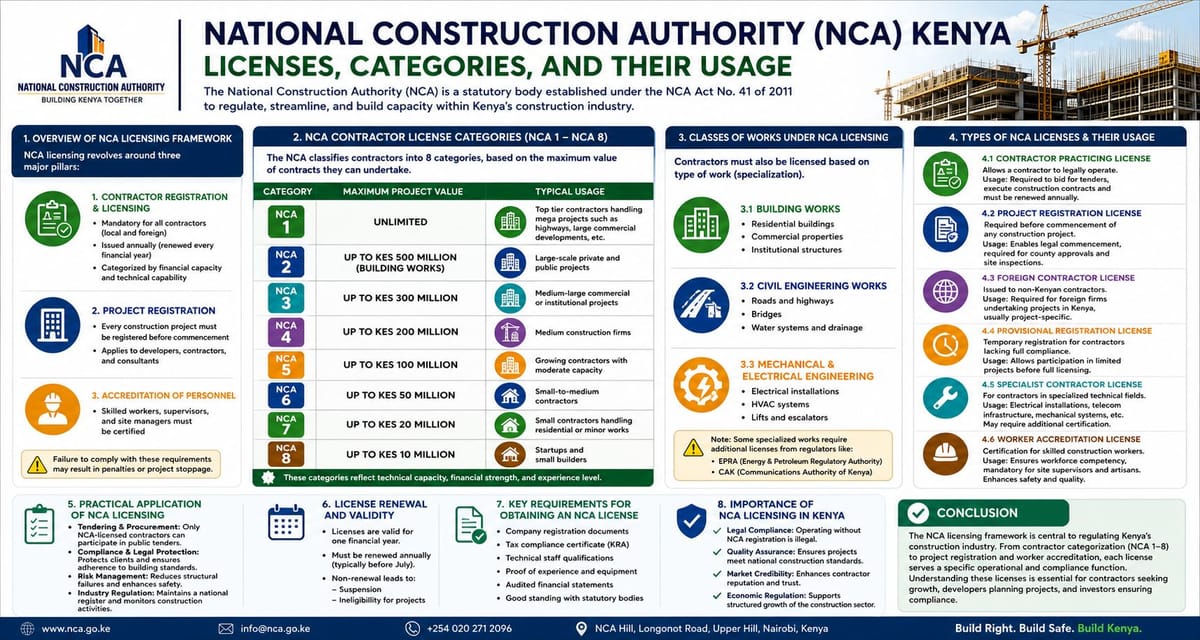
The National Construction Authority (NCA) is a statutory body established under the NCA Act No. 41 of 2011 to regulate, streamline, and build capacity within Kenya’s construction industry. Its core mandate includes contractor registration, project regulation, and enforcement of construction standards. (National Construction Authority)
A key compliance requirement is that no contractor can legally undertake construction work without an NCA registration and a valid practicing license. (National Construction Authority)
1. Overview of NCA Licensing Framework
NCA licensing revolves around three major pillars:
1. Contractor Registration & Licensing
- Mandatory for all contractors (local and foreign)
- Issued annually (renewed every financial year)
- Categorized by financial capacity and technical capability
2. Project Registration
- Every construction project must be registered before commencement
- Applies to developers, contractors, and consultants
3. Accreditation of Personnel
- Skilled workers, supervisors, and site managers must be certified
Failure to comply with these requirements may result in penalties or project stoppage. (CK)
2. NCA Contractor License Categories (NCA 1 – NCA 8)
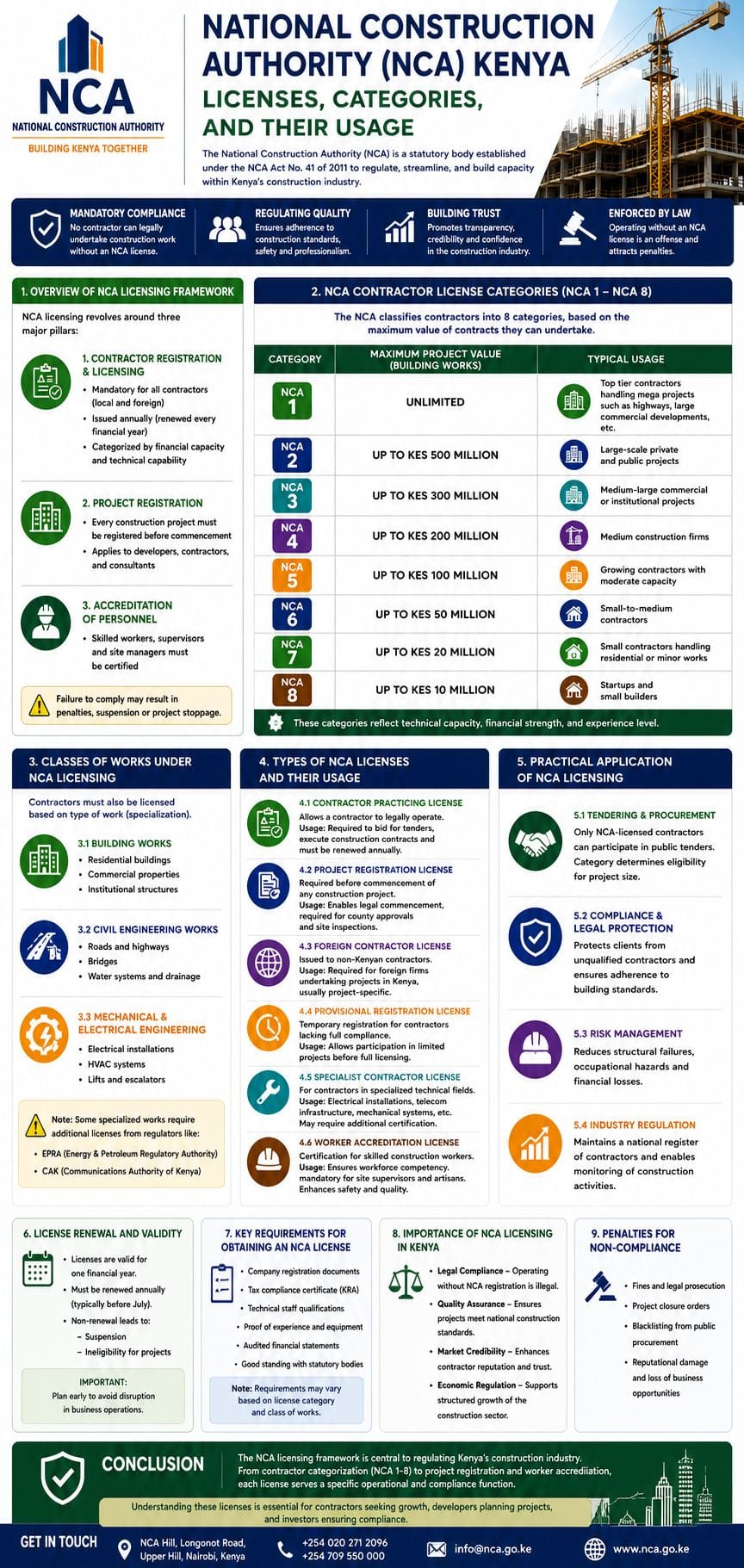
The NCA classifies contractors into 8 categories, based on the maximum value of contracts they can undertake.
2.1 Category Breakdown
🔹 NCA 1 (Top Tier)
- Unlimited project value
- Used by large contractors handling mega projects
- Example: highways, large commercial developments
🔹 NCA 2
- Up to KES 500M (building works)
- Large-scale private and public projects
🔹 NCA 3
- Up to KES 300M
- Medium-large commercial or institutional projects
🔹 NCA 4
- Up to KES 200M
- Medium construction firms
🔹 NCA 5
- Up to KES 100M
- Growing contractors with moderate capacity
🔹 NCA 6
- Up to KES 50M
- Small-to-medium contractors
🔹 NCA 7
- Up to KES 20M
- Small contractors handling residential or minor works
🔹 NCA 8 (Entry Level)
- Up to KES 10M
- Startups and small builders
These categories reflect technical capacity, financial strength, and experience level. (National Construction Authority)
3. Classes of Works Under NCA Licensing
Apart from categories, contractors must also be licensed based on type of work (specialization).
3.1 Building Works
- Residential buildings
- Commercial properties
- Institutional structures
3.2 Civil Engineering Works
- Roads and highways
- Bridges
- Water systems and drainage
3.3 Mechanical & Electrical Engineering
- Electrical installations
- HVAC systems
- Lifts and escalators
⚠️ Note: Some specialized works require additional licenses from regulators like:
- EPRA (Energy & Petroleum Regulatory Authority)
- CAK (Communications Authority of Kenya) (National Construction Authority)
4. Types of NCA Licenses and Their Usage
4.1 Contractor Practicing License
Description
Issued after registration, this license allows a contractor to legally operate.
Usage
- Required to bid for tenders
- Mandatory for executing construction contracts
- Must be renewed annually
4.2 Project Registration License
Description
Every construction project must be registered with NCA before commencement.
Usage
- Enables legal commencement of construction
- Required for:
- County approvals
- Site inspections
- Ensures regulatory compliance and safety
Requirements include:
- Approved drawings
- Registered contractor & consultants
- Signed contract agreements (NCA Mail)
4.3 Foreign Contractor License
Description
Issued to non-Kenyan contractors.
Usage
- Required for foreign firms undertaking projects in Kenya
- Usually project-specific
- Often requires local partnership
4.4 Provisional Registration License
Description
Temporary registration for contractors lacking full compliance.
Usage
- Allows participation in limited projects
- Transitional status before full licensing
4.5 Specialist Contractor License
Description
For contractors in specialized technical fields.
Usage
- Electrical installations
- Telecommunications infrastructure
- Mechanical systems
Requires additional certification from sector regulators.
4.6 Worker Accreditation License
Description
Certification for skilled construction workers.
Usage
- Ensures workforce competency
- Mandatory for site supervisors and artisans
- Enhances safety and quality
5. Practical Application of NCA Licensing
5.1 Tendering and Procurement
- Only NCA-licensed contractors can participate in public tenders
- Category determines eligibility for project size
5.2 Compliance and Legal Protection
- Protects clients from unqualified contractors
- Ensures adherence to building standards
5.3 Risk Management
- Reduces structural failures
- Enhances occupational safety
5.4 Industry Regulation
- Maintains a national register of contractors
- Enables monitoring of construction activities
6. License Renewal and Validity
- Licenses are valid for one financial year
- Must be renewed annually (typically before July) (National Construction Authority)
- Non-renewal leads to:
- Suspension
- Ineligibility for projects
7. Key Requirements for Obtaining an NCA License
Typical requirements include:
- Company registration documents
- Tax compliance certificate (KRA)
- Technical staff qualifications
- Proof of experience and equipment
- Audited financial statements (National Construction Authority)
8. Importance of NCA Licensing in Kenya
✔ Legal Compliance
Operating without NCA registration is illegal.
✔ Quality Assurance
Ensures projects meet national construction standards.
✔ Market Credibility
Enhances contractor reputation and trust.
✔ Economic Regulation
Supports structured growth of the construction sector.
========================
The National Construction Authority licensing framework is central to regulating Kenya’s construction industry. From contractor categorization (NCA 1–8) to project registration and worker accreditation, each license serves a specific operational and compliance function.
Understanding these licenses is essential for:
- Contractors seeking growth
- Developers planning projects
- Investors ensuring compliance