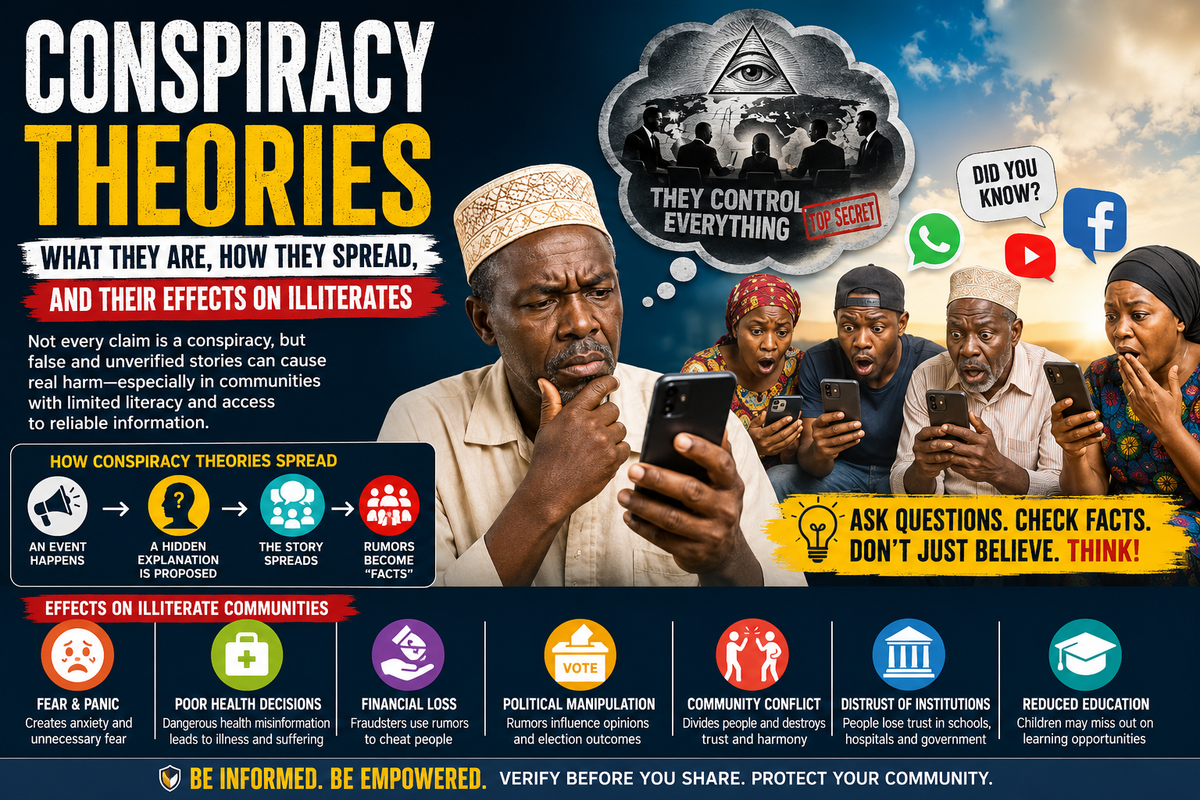
Conspiracy Theories: What They Are, How They Spread, and Their Effects on Illiterate Communities

Introduction
Conspiracy theories have existed for centuries, but the rise of social media, smartphones, messaging applications, and online video platforms has made them easier than ever to spread.
A conspiracy theory usually presents an explanation for an event by claiming that a powerful person, organization, government, company, or secret group is deliberately hiding the truth or secretly controlling what is happening.
Some conspiracies are real. Governments, companies, criminal groups, and individuals have genuinely participated in secret wrongdoing throughout history. However, a conspiracy theory becomes problematic when serious claims are accepted without reliable evidence, or when every piece of evidence against the theory is simply treated as proof that the conspiracy is being covered up.
For people who have limited literacy, access to formal education, or experience evaluating written information, conspiracy theories can be particularly difficult to identify and challenge. This does not mean that illiterate people are unintelligent. Literacy and intelligence are different things. A person may have little formal education but possess tremendous practical knowledge, wisdom, and experience.
The real issue is access to reliable information and the ability to verify claims.
What Is a Conspiracy Theory?
A conspiracy theory is a belief or explanation that says an important event or situation is secretly being controlled or manipulated by a group of people working together.
For example, imagine someone says:
"The government secretly caused this problem, but they are hiding the evidence."
That is a claim of conspiracy. It may or may not be true. The important question is:
What evidence supports the claim?
A claim should not automatically become true simply because many people repeat it.
Illustration 1: How a conspiracy theory develops
An event happens → Someone proposes a hidden explanation → The story spreads → People repeat it → More people believe it → Rumours become accepted as "facts"
This process can be compared to a small spark becoming a large fire. A single unverified message can travel through hundreds or thousands of people before anyone asks where it came from.
Conspiracy Theory vs. Genuine Conspiracy
It is important not to make the mistake of saying that every conspiracy claim is false.
Real conspiracies exist.
A genuine conspiracy normally leaves evidence such as:
- Documents
- Financial records
- Emails or communications
- Witness testimony
- Official investigations
- Court records
- Physical evidence
- Independent confirmation
A conspiracy theory, on the other hand, may depend heavily on:
- Rumours
- Anonymous claims
- Fear
- Suspicion
- Misinterpreted events
- Edited videos
- Unverified WhatsApp messages
- "Someone told me" stories
- Claims that cannot be independently checked
A simple example
If someone says:
"I heard that a certain medicine is dangerous because my neighbour's friend said so."
That is not enough evidence.
A better approach is to ask:
Who made the claim? What evidence do they have? Can the information be checked with doctors, health authorities, scientific research, or other trustworthy sources?
Why Do People Believe Conspiracy Theories?
People do not necessarily believe conspiracy theories because they are unintelligent.
Human beings naturally try to find explanations for confusing or frightening events.
When something unexpected happens, people often ask:
"Why did this happen?"
When a clear answer is unavailable, a simple story can become attractive.
Several factors can contribute to belief in conspiracy theories.
1. Fear
Fear makes people more likely to accept explanations that appear to explain danger.
For example, during a disease outbreak, people may hear many different explanations about where the disease came from, how it spreads, or who is responsible.
A frightening claim can spread faster than a careful scientific explanation.
2. Lack of Reliable Information
When people cannot easily access newspapers, books, trusted websites, government announcements, schools, libraries, or knowledgeable professionals, rumours may become their main source of information.
This can be especially important in communities where information is primarily passed through:
- Word of mouth
- Community meetings
- Churches and mosques
- Local markets
- Public transport
- Radio
- WhatsApp groups
- Family conversations
These communication channels are valuable, but information received through them still needs to be checked.
3. Repetition
A false statement can begin to feel true simply because someone hears it repeatedly.
Imagine a person hears the same claim from five different people:
"Everybody is saying it, so it must be true."
But those five people may all have received the information from the same original rumour.
The number of people repeating a claim does not automatically increase the quality of its evidence.
Illustration 2: The rumour chain
Person A → Person B → Person C → Person D → 100 people
By the time the story reaches Person D, nobody may remember where it originally came from.
The story can change at every stage.
Why Illiterate People Can Be More Vulnerable to Misinformation
The term illiterate generally refers to someone who cannot read and write adequately. However, it is important to avoid using the word as an insult.
A person who cannot read may still be highly knowledgeable about farming, fishing, construction, business, livestock, traditional practices, mechanics, or their local community.
The challenge is different:
Limited literacy can make it harder to independently verify written information.
For example, someone receives a message saying:
"Government officials have announced that everyone must do X."
A person who can read may be able to search for the announcement, visit an official website, read the original document, compare several news reports, and determine whether it is genuine.
Someone who cannot read may depend entirely on the person who sent the message to explain it.
This creates an information dependency.
The Role of Audio and Video
Conspiracy theories do not require literacy to spread.
In fact, audio and video can make misinformation particularly powerful.
A person may receive a voice recording saying:
"I have information from someone inside the government..."
Because the message is spoken confidently, listeners may assume the speaker is knowledgeable.
Similarly, a video showing an unusual event can be accompanied by a completely false explanation.
Illustration 3: How video can mislead
Real video + false explanation = misleading story
For example:
Video: A large crowd running.
Claim: "People are running because something dangerous has happened."
But the actual reason could be completely different.
The video itself may be real while the explanation attached to it is false.
The Effects of Conspiracy Theories on Illiterate Communities
The effects can be significant, particularly when rumours influence decisions involving health, education, politics, money, security, or community relationships.
1. Fear and Panic
Conspiracy theories can create unnecessary fear.
People may become frightened about:
- Diseases
- Vaccinations
- Government programmes
- New technology
- Schools
- Businesses
- Elections
- Religious or community groups
- Foreign organizations
Fear can cause people to make decisions before they have checked the facts.
2. Poor Health Decisions
Health misinformation can be especially dangerous.
A conspiracy theory might claim that a legitimate medical treatment is secretly designed to harm people.
If people believe such claims without checking reliable medical information, they may avoid seeking appropriate healthcare.
The consequences can include delayed treatment, preventable illness, and unnecessary suffering.
This is one of the areas where misinformation can move from being merely annoying to becoming genuinely dangerous.
3. Financial Loss
Conspiracy theories can also be used to manipulate people financially.
A person may be told:
"The government is about to ban this investment, so send money now."
Or:
"Only our group knows about this secret opportunity."
Such claims can create urgency and discourage people from asking questions.
Fraudsters sometimes deliberately use secretive language because it makes their schemes appear exclusive.
4. Political Manipulation
Conspiracy theories can influence political opinions.
People may be told that:
- An election was secretly controlled.
- A particular community is responsible for a problem.
- A politician secretly controls everything.
- A government programme has a hidden purpose.
Without reliable information, people may make important political decisions based on rumours rather than evidence.
5. Community Conflict
Conspiracy theories can divide communities.
A rumour may accuse one ethnic, religious, political, social, or economic group of secretly causing problems.
Once such accusations spread, suspicion can replace cooperation.
This can damage relationships between:
- Neighbours
- Families
- Communities
- Religious groups
- Political supporters
- Businesses and customers
A rumour that takes five minutes to create can sometimes take years to repair.
6. Distrust of Institutions
Repeated conspiracy theories can cause people to distrust institutions that are actually providing useful services.
These may include:
- Schools
- Hospitals
- Government offices
- Banks
- Courts
- Police
- Universities
- Scientific institutions
- Non-governmental organizations
Healthy questioning is valuable.
But there is a difference between:
"I want evidence before I believe this."
and
"Everyone involved is lying, so no evidence can ever be trusted."
The first is critical thinking.
The second can make it almost impossible to correct misinformation.
7. Children Can Also Be Affected
Children often learn from adults around them.
If parents, relatives, community leaders, or friends repeatedly present rumours as facts, children may accept those claims before developing the skills needed to evaluate them.
This is why teaching children to ask questions is important.
Instead of simply telling children:
"Don't believe that."
teach them to ask:
- Who said it?
- Where did the information come from?
- What evidence exists?
- Can we check another source?
- Could there be another explanation?
These questions create a mental shield against misinformation.
8. Reduced Participation in Education
Some conspiracy theories can create suspicion toward education itself.
For example, false claims may suggest that schools are secretly designed to manipulate children or that teachers are part of a hidden plan.
When parents believe such claims, they may discourage children from attending school or accessing useful educational resources.
This can create a cycle:
Less education → Less access to information → Greater dependence on rumours → More misinformation
Breaking this cycle requires accessible education and trustworthy communication.
The Problem Is Not Intelligence
This point deserves special emphasis.
Illiteracy does not mean stupidity.
An elderly farmer who cannot read may know exactly when to plant crops by observing weather patterns, soil conditions, insects, and seasons.
A fisherman may understand the sea better than someone with several academic degrees.
A mechanic may diagnose an engine problem without reading a technical manual.
Knowledge exists in many forms.
The problem arises when someone lacks the tools needed to verify unfamiliar information.
Therefore, the solution should not be mocking people.
The solution is education, accessible information, patience, and trustworthy communication.
How Communities Can Fight Conspiracy Theories
1. Encourage Questions
People should feel comfortable saying:
"I don't know."
and
"Let us check."
These two phrases are powerful weapons against misinformation.
2. Use Simple Language
Information intended for communities with low literacy should not depend entirely on complicated written documents.
Important public information can be communicated through:
- Radio
- Community meetings
- Simple posters
- Pictures
- Local languages
- Audio recordings
- Demonstrations
- Community health workers
- Teachers
- Religious leaders
- Trusted local leaders
3. Teach Media Literacy
Media literacy means understanding how to evaluate information.
People can learn simple rules such as:
STOP before sharing.
S = Stop
Do not immediately forward the message.
T = Think
Does the claim make sense?
O = Observe the source
Who created or announced it?
P = Prove
Can the claim be confirmed independently?
This simple four-step method can be taught verbally, visually, and through community education.
A Simple Five-Question Test
Before believing or forwarding a surprising claim, ask:
1. Who said it?
Is there a real person or organization behind the claim?
2. What evidence do they have?
Is there documentation, data, official information, or independent confirmation?
3. Where did the information originate?
Can you find the original source?
4. Can another trusted source confirm it?
Do not rely on one person or one message.
5. What happens if I am wrong?
This final question is extremely important.
If believing the claim could affect someone's health, money, safety, education, or relationships, slow down and verify it before acting.
The Importance of Trusted Community Leaders
In communities where literacy levels are low, trusted individuals can play a major role in combating misinformation.
These may include:
- Teachers
- Nurses
- Doctors
- Religious leaders
- Chiefs and local administrators
- Community health workers
- Elders
- Journalists
- Agricultural officers
- Professional organizations
However, being a respected person does not automatically make every statement correct.
Community leaders should also encourage people to verify information rather than simply asking people to trust them.
Technology: The Problem and the Solution
Technology has made misinformation easier to spread.
A smartphone can transmit a rumour to thousands of people within minutes.
But technology can also help fight misinformation.
For example:
- Radio programmes can explain false claims.
- Educational videos can use local languages.
- WhatsApp voice messages can reach people who cannot read.
- Community websites can publish official information.
- Social media can provide corrections.
- Search engines can help people investigate claims.
Technology itself is neither the villain nor the hero.
How people use it determines its impact.
Illustration: The Information Highway
Imagine information as vehicles travelling along a highway.
A verified fact is like a vehicle that has passed inspection.
A rumour is like a vehicle with no inspection sticker.
If people allow every vehicle onto the highway without checking it, accidents become inevitable.
The solution is not to close the highway.
The solution is to create better inspection systems.
In the same way, society should not stop people from communicating.
It should teach people how to check information before passing it forward.
What Families Can Do
Families can help by creating an environment where questions are welcomed.
When someone receives a suspicious message, family members can discuss it together.
For example:
"We have received this message. Do we know who produced it?"
"Can we find the original announcement?"
"Could there be another explanation?"
This approach is better than simply saying:
"That is nonsense."
Mocking someone can make them defensive.
Respectful discussion creates room for learning.
What Governments and Organizations Can Do
Public institutions should understand that publishing information on a website is not enough.
If a significant part of the population has limited literacy or limited internet access, information must also reach people through appropriate channels.
Effective public communication can include:
- Local radio
- Local languages
- Community meetings
- Visual posters
- Short audio messages
- Simple explanations
- Question-and-answer sessions
- Trusted community representatives
Most importantly, authorities should communicate early.
When official information is absent, rumours often rush in to fill the empty space.
Conspiracy Theories in the Digital Age
Social media algorithms and messaging networks can create information bubbles.
People may repeatedly encounter information that agrees with what they already believe.
This can produce a dangerous effect:
"I keep seeing this everywhere, therefore it must be true."
But seeing something repeatedly does not prove it.
A false story can become extremely popular.
A true story can remain relatively unknown.
Popularity is not evidence.
Conclusion
Conspiracy theories are not simply stories about secret groups.
They are part of a larger problem involving misinformation, fear, uncertainty, limited access to reliable information, and human psychology.
For people with limited literacy, the challenge is often not intelligence. It is access to information and the ability to independently verify unfamiliar claims.
Communities can reduce the impact of conspiracy theories by promoting:
- Accessible education
- Media literacy
- Critical thinking
- Local-language communication
- Trusted public information
- Community discussions
- Responsible use of social media
- Verification before sharing
The most important lesson is simple:
Do not believe something simply because it is repeated many times. Ask where the information came from, look for evidence, and check before you share or act on it.
In a world where information can travel faster than the truth, the ability to ask "How do we know?" is one of the most valuable skills a person can have.