KRA “Shuru” WhatsApp Chatbot — Complete Guide, Use Cases & Practical Walkflows (Kenya)

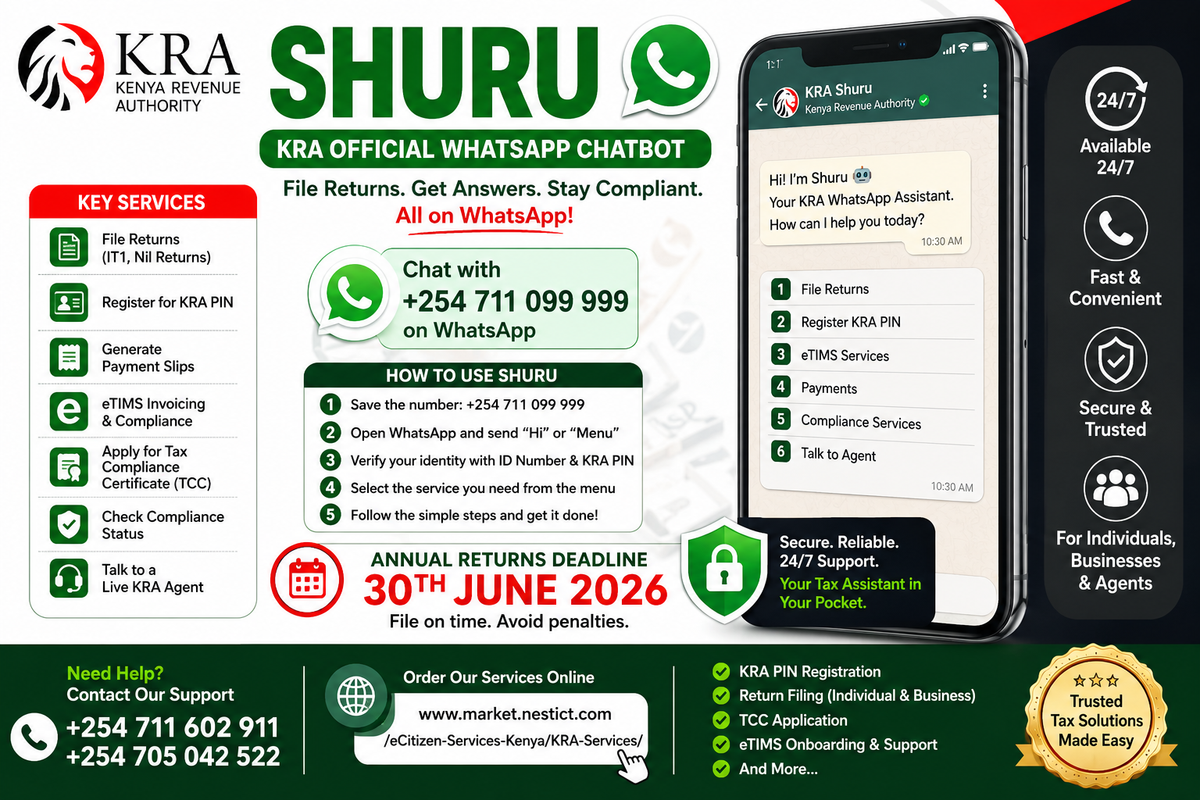
The Kenya Revenue Authority has rolled out “Shuru”, an official WhatsApp-based virtual assistant designed to digitize and simplify tax compliance. It removes friction from traditional iTax workflows by enabling core services directly via mobile messaging—no browser sessions, no physical visits.
With Kenya targeting over 22 million new taxpayers, Shuru is not just a convenience tool—it’s part of a broader compliance expansion strategy.
1. What is KRA “Shuru”?
Shuru is a conversational AI chatbot integrated into WhatsApp that allows taxpayers to:
- Register for a KRA PIN
- File IT1 (Individual Income Tax) returns
- Generate payment slips
- Access eTIMS (electronic Tax Invoice Management System)
- Apply for Tax Compliance Certificates (TCC)
- Verify compliance status
- Escalate to a live KRA agent
It operates 24/7 and is optimized for both smartphones and basic internet users.
2. Why Shuru Matters (Technical & Operational Perspective)
Traditional iTax Challenges
- Session timeouts
- Browser/device compatibility issues
- CAPTCHA and login failures
- High dependency on cybercafés or agents
Shuru Advantages
- Stateless conversational flow (reduces session failures)
- Mobile-first design (aligned with Kenya’s WhatsApp penetration)
- Reduced infrastructure overhead (no heavy front-end rendering)
- Guided workflows → lower user error rates
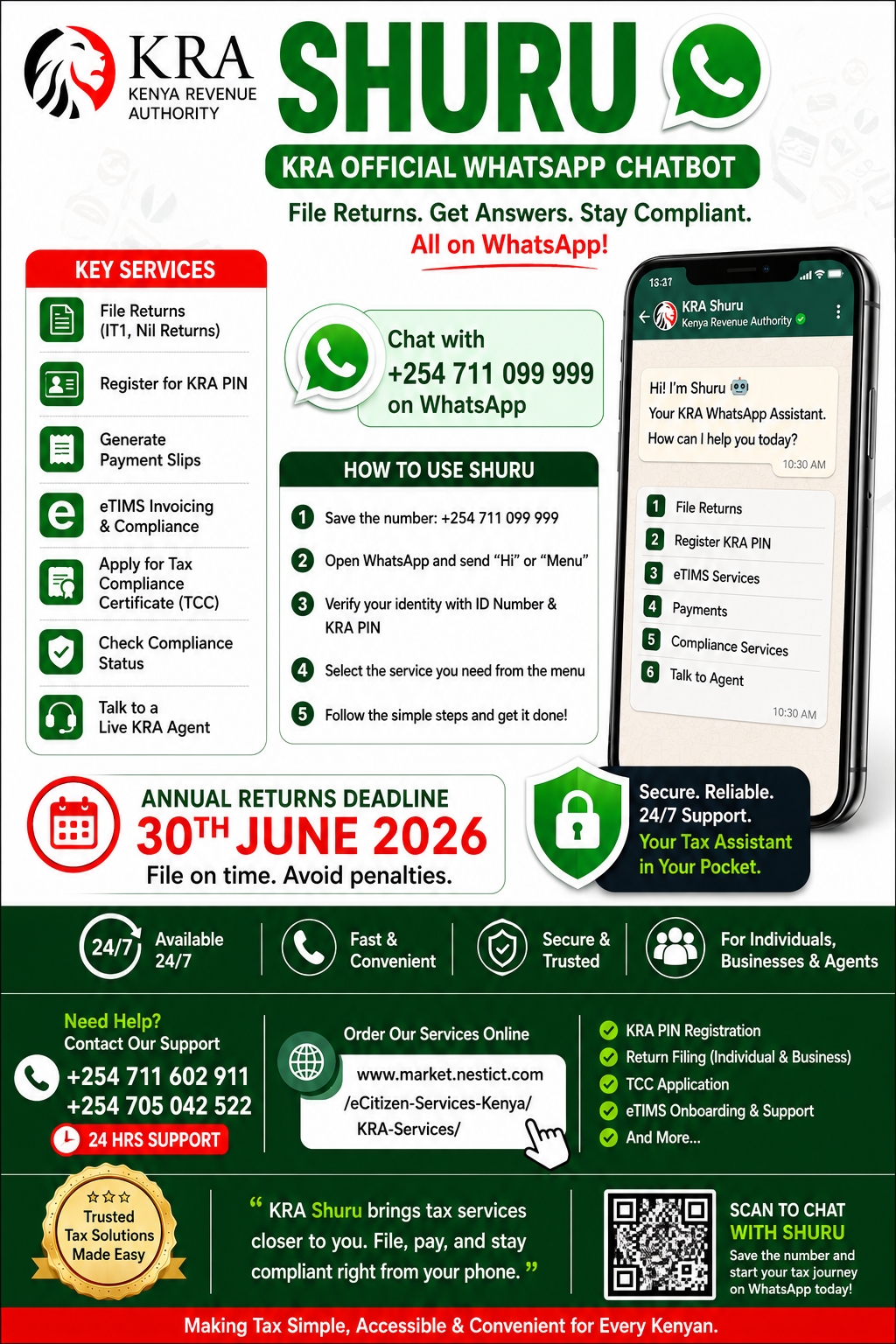
3. Getting Started (Step-by-Step Setup)
Step 1: Save Official Contact
+254 711 099 999
Step 2: Initiate Chat
Send:
Hi
or
Menu
Step 3: Identity Verification
You will be prompted to provide:
- National ID Number
- KRA PIN
This is a secure validation layer mapped to KRA’s backend taxpayer registry.
Step 4: Access Main Menu
You’ll see options like:
- File Returns
- Register PIN
- eTIMS Services
- Payments
- Compliance Services
4. Core Services Explained (With Use Cases)
4.1 Filing Annual Returns (IT1)
Use Case: Individuals filing NIL or employment income returns
Workflow:
- Select:
File Returns - Choose:
Individual (IT1) - Confirm income type:
- Nil Return
- Employment Income (P9 upload guidance)
- System validates entries
- Submit → Confirmation generated
Output:
- Filing acknowledgment
- Return receipt number
4.2 NIL Returns (Most Common in Kenya)
Ideal for:
- Students
- Unemployed individuals
- Dormant businesses
Time to complete: < 2 minutes
4.3 KRA PIN Registration
Target Users:
- First-time employees
- Business owners
- Tender applicants
Required:
- National ID
- Phone number
4.4 Tax Payments
Shuru allows:
- Payment registration
- Slip generation
Payment Channels:
- M-Pesa Paybill
- Bank transfer
4.5 eTIMS Integration
Relevant for:
- SMEs
- VAT-registered businesses
Functions:
- Invoice validation
- Device registration guidance
- Compliance checks
4.6 Tax Compliance Certificate (TCC)
Critical for:
- Government tenders
- Business licensing
Process:
- Select
Compliance - Apply for TCC
- Track application status
4.7 Live Agent Escalation
If the chatbot cannot resolve your issue:
- Select:
Talk to Agent - You’ll be connected to a human KRA support officer
5. Practical Walkthrough: Filing NIL Return via Shuru
Command Flow:
Hi → File Returns → Individual → NIL Return → Confirm → Submit
System Response:
- “Your NIL return has been successfully filed”
- Receipt generated instantly
6. Security & Data Handling
Shuru integrates with:
- KRA iTax backend APIs
- National ID validation systems
Security mechanisms:
- OTP / identity verification
- Encrypted WhatsApp communication
- Session-based authorization
7. Limitations You Should Know
- Complex filings (e.g., multiple income streams, business audits) still require iTax portal
- Document uploads (e.g., P9 forms) are limited in chatbot format
- Dependent on WhatsApp connectivity
8. Compliance Deadline (CRITICAL)
📅 Annual Returns Deadline: 30th June 2026
Failure to file:
- KES 2,000 penalty (individuals)
- Higher penalties for businesses
9. Business & Cybercafé Opportunity Insight (Kenya Context)
For operators like NESTICT INFOTECH, Shuru introduces both:
Threat:
- Reduced walk-in traffic for simple services (e.g., NIL returns)
Opportunity:
- Offer assisted services:
- Complex tax filings
- eTIMS onboarding
- Compliance consulting
- Bulk filings for SMEs
10. When Shuru is NOT Enough (Professional Support)
If you are:
- Filing complex returns
- Handling business taxes
- Facing compliance issues
- Managing multiple taxpayer accounts
You will still need expert intervention.
🚀 Get Assisted KRA Services (24/7 Support)
If you're stuck or want a fully managed solution:
- 🌐 KRA Services Portal (NESTICT Market)
- 📞 +254 711 602 911
- 📞 +254 705 042 522
Services include:
- Return filing (Individual & Business)
- KRA PIN registration
- TCC applications
- eTIMS onboarding
- Error resolution
11. Final Assessment
KRA Shuru represents a paradigm shift in tax administration in Kenya:
- Moves compliance from web → conversational interface
- Reduces dependency on intermediaries
- Expands tax base accessibility
- Aligns with Kenya’s mobile-first digital economy