How to Use the Benefit of the Doubt with 90% Precision (A Data-Driven Life Coaching Guide)

Introduction
In complex environments—business operations, leadership, and interpersonal dynamics—decision quality depends on how accurately you interpret intent under uncertainty.
The “benefit of the doubt” is often treated as emotional generosity. In reality, it can be engineered into a high-precision cognitive model using structured inputs and probabilistic reasoning.
What Does “Benefit of the Doubt” Mean (System View)
A controlled inference engine that defaults to neutral/positive intent when negative intent probability is below a defined threshold.
🔷 Technical Illustration 1: Intent Evaluation Pipeline
flowchart LR
A[Observed Behavior] --> B[Historical Data Check]
B --> C[Context Analysis]
C --> D[Pattern Consistency Check]
D --> E[Probability Scoring Engine]
E --> F{Threshold >= 0.7?}
F -- Yes --> G[Extend Benefit of Doubt]
F -- No --> H[Escalate / Investigate]
Why People Misjudge (Bias Layer Interference)
Human judgement is distorted by built-in “noise” layers:
- Negativity bias → inflates threat probability
- Attribution error → ignores environmental variables
- Confirmation bias → locks early assumptions
🔷 Technical Illustration 2: Bias Distortion Model
flowchart TD
A[Raw Observation] --> B[Bias Filter]
B --> C[Distorted Interpretation]
C --> D[Incorrect Decision]

subgraph Bias Filter
B1[Negativity Bias]
B2[Attribution Error]
B3[Confirmation Bias]
end
The 90% Precision Model (Mathematical Framework)
We define:
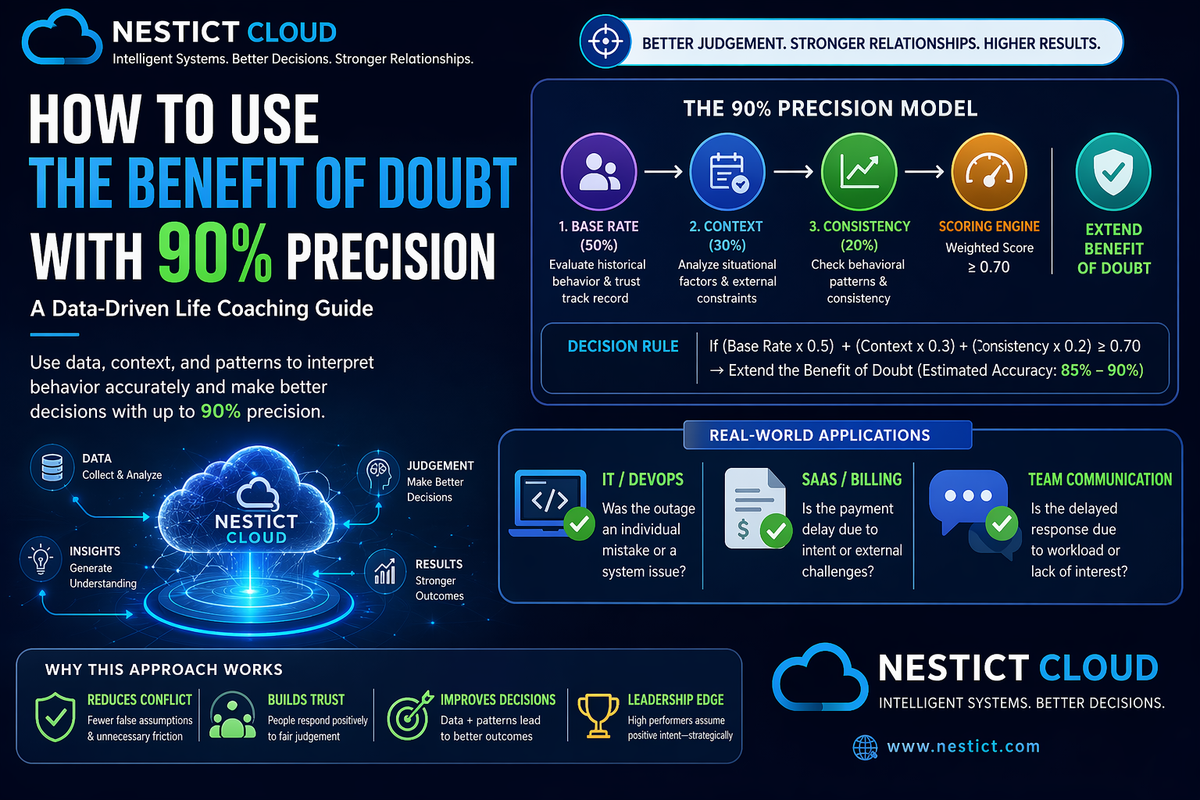
P(Negative Intent | Behavior) = f(Base Rate, Context, Consistency)
Weighted Model:
- Base Rate (Historical Trust Score) → 0.5
- Context Score → 0.3
- Consistency Score → 0.2
🔷 Technical Illustration 3: Scoring Algorithm
def benefit_of_doubt_score(base_rate, context, consistency):
    score = (base_rate * 0.5) + (context * 0.3) + (consistency * 0.2)

    if score >= 0.7:
        return "Extend Benefit of Doubt"
    else:
        return "Investigate Further"
Real-World Technical Scenarios
Scenario 1: DevOps / IT Operations
Problem: Service downtime caused by engineer
🔷 Illustration: Incident Decision Flow
flowchart LR
A[Service Failure] --> B[Check Engineer History]
B --> C{Reliable?}
C -- Yes --> D[Check System Logs]
D --> E[External Factors?]
E -- Yes --> F[Benefit of Doubt]
E -- No --> G[Further Audit]
C -- No --> G
Insight:
Most outages are systemic—not individual negligence.
Scenario 2: SaaS Billing / CRM Systems
Problem: Client fails to pay invoice
🔷 Illustration: Client Risk Evaluation Matrix
+----------------------+------------------+
| Factor               | Score (0–1)      |
+----------------------+------------------+
| Payment History      | 0.9              |
| Economic Context     | 0.7              |
| Communication Level  | 0.8              |
+----------------------+------------------+

Weighted Score = 0.82 → TRUST
Decision: Maintain service continuity with controlled reminders.
Scenario 3: Team Communication Systems
Problem: Delayed response in Slack/Email
🔷 Illustration: Response Delay Model
flowchart TD
A[Delayed Reply] --> B[Check Time Zone]
B --> C[Check Workload]
C --> D[Check Past Responsiveness]
D --> E{Pattern Deviation?}
E -- No --> F[Ignore / Trust]
E -- Yes --> G[Follow Up]
When the Model Fails (Exception Handling Layer)
flowchart TD
A[Repeated Negative Behavior] --> B[Pattern Established]
B --> C[Override Trust Model]
C --> D[Switch to Evidence-Based Decision]
Benefits of This System
1. Reduced False Positives
You stop incorrectly labeling neutral actions as negative.
2. Increased System Stability
Less emotional volatility in teams and operations.
3. Scalable Decision Framework
Can be applied across:
- HR systems
- CRM workflows
- Leadership models
🔷 Technical Illustration 4: Decision System Architecture
flowchart LR
A[Input Layer: Behavior Data] --> B[Processing Layer: Scoring Engine]
B --> C[Decision Layer]
C --> D[Action Layer]

D --> E[Trust Response]
D --> F[Investigation Response]
Daily Implementation Algorithm
INPUT: observed_behavior

1. Retrieve historical trust score
2. Evaluate current context
3. Check behavioral consistency
4. Compute weighted probability
5. IF score >= threshold:
       apply benefit_of_doubt
   ELSE:
       investigate
The benefit of the doubt is not a soft skill—it is a decision optimization strategy.
By modeling human interactions like a system—with inputs, weights, and thresholds—you significantly improve judgement accuracy and reduce cognitive error rates.
This is how high-performing leaders and systems achieve ~90% precision in interpreting intent.