KRA Annual Tax Returns Deadline Moves From June 30 to April 30

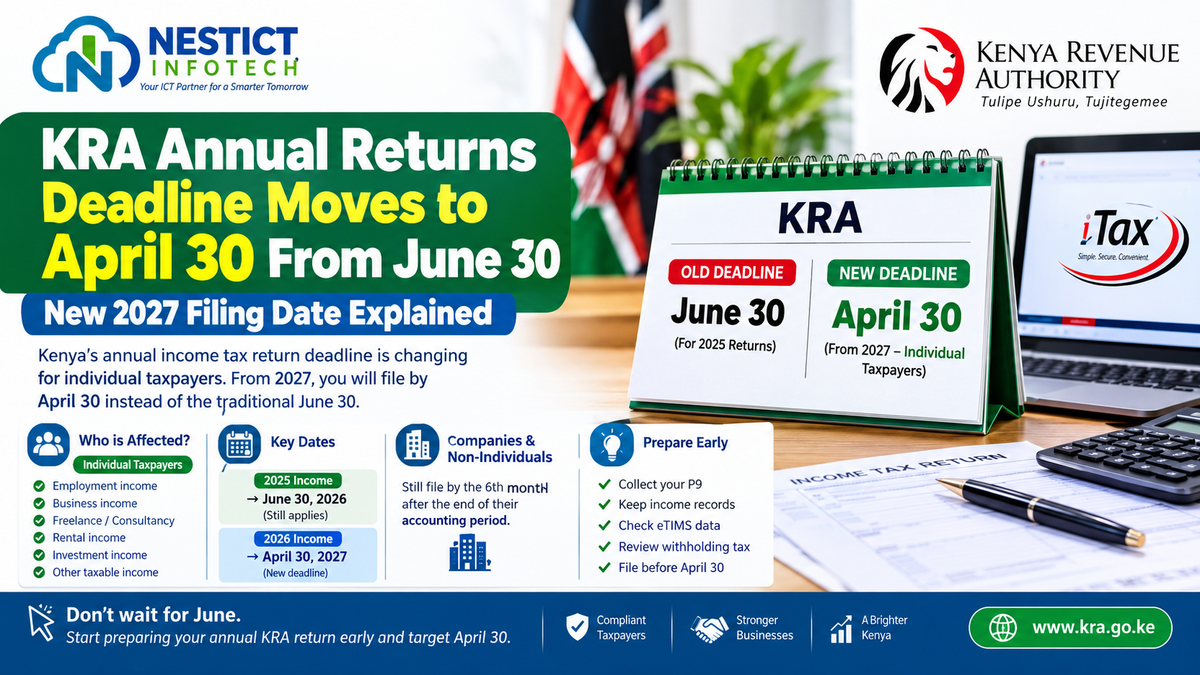
Kenya's familiar June 30 tax-return deadline is changing for individual taxpayers. From 2027, eligible individual taxpayers will have to file their annual income tax returns by April 30 instead of the traditional June 30 deadline.
The change follows amendments introduced through the Finance Act, 2026, which changed the statutory filing timeline for individual income tax returns.
For many Kenyans, this means the annual KRA return calendar is moving forward by two months.
However, it is important to understand that April 30 does not replace June 30 for every taxpayer.
What Has Changed?
Under the new framework, individual taxpayers will be required to submit their income tax returns by the last day of the fourth month after the end of the year of income.
Since individual taxpayers generally use the calendar year, the calculation is:
Year of income: 1 January to 31 December
Fourth month after year-end: April
New deadline: 30 April
KRA confirms that the new individual filing deadline takes effect from 1 January 2027.
Example
For the 2026 Year of Income:
- Income period: 1 January 2026 – 31 December 2026
- Filing begins: 1 January 2027
- New deadline: 30 April 2027
Therefore, taxpayers should not wait until June 2027 to file their 2026 individual income tax return.
What Happened to the June 30 Deadline?
For many years, June 30 has been the familiar deadline for annual individual income tax returns in Kenya.
For example, KRA's 2026 filing guidance required taxpayers to file returns for the 2025 Year of Income between 1 January 2026 and 30 June 2026.
That deadline still applied to the 2025 return.
The change begins with the 2026 Year of Income, which will be filed in 2027.
In other words:
| Year of Income | Filing Year | Individual Deadline |
|---|---|---|
| 2025 | 2026 | 30 June 2026 |
| 2026 | 2027 | 30 April 2027 |
| 2027 | 2028 | 30 April 2028 |
| 2028 | 2029 | 30 April 2029 |
Who Will Be Affected?
The April deadline applies to individual taxpayers under the new framework.
This includes individuals who may have:
- Employment income
- Business income
- Freelance income
- Consultancy income
- Rental income
- Investment income
- Other taxable income
- No income but an active Income Tax obligation
KRA currently states that individuals with a KRA PIN and Income Tax obligation are required to file an annual return, including where there was no income to declare.
Salaried Employees Should Take Note
Employees whose income is fully taxed through PAYE may have become accustomed to receiving their P9 and then waiting until June to complete their annual return.
That timetable is changing.
Employees should therefore start collecting their annual tax information earlier, including:
- P9 certificate
- Employment income details
- PAYE deductions
- Benefits and allowances
- Pension information
- Insurance information where applicable
- Other income
- Withholding tax certificates
- Supporting documentation for applicable claims
KRA says employment information may be pre-populated on iTax and taxpayers should review the information before submitting the return.
What About People With Side Hustles?
The April deadline is particularly important for people who have employment income plus additional sources of income.
For example, someone may be:
Employed + Freelancing + Online Business
or:
Employed + Rental Income
or:
Employed + Consultancy
Such income should not simply be ignored because PAYE was already deducted from the salary.
KRA's filing guidance states that individuals with employment income and additional income should declare both in the annual income tax return.
This means taxpayers with side businesses should begin preparing their records well before April.
What About Nil Returns?
Having no income does not automatically mean that an individual with an Income Tax obligation can ignore the annual filing requirement.
KRA states that a person with a KRA PIN and Income Tax obligation must file an annual return even where there was no income, in which case a Nil Return is filed.
The broader 2026 reforms have introduced different filing timelines and taxpayers should therefore check the applicable obligation and KRA guidance rather than assuming that every taxpayer follows the same date.
Are Companies Also Moving to April?
No.
This is one of the most important points to understand.
KRA's explanation of the Finance Act 2026 states that companies and other non-individual taxpayers continue to file by the last day of the sixth month after the end of their accounting period.
Therefore, the change should not be described as:
"KRA has moved everyone's annual returns from June to April."
A more accurate description is:
"KRA has moved the individual income tax return deadline from June 30 to April 30 from 2027."
The distinction matters because individual taxpayers and companies can have different filing deadlines.
Why Taxpayers Should Start Preparing Earlier
The new deadline gives individuals less time after the end of the calendar year to finalise their tax information.
Instead of having until the end of June, taxpayers will need to have their information ready by the end of April.
A practical preparation calendar could look like this:
January
Start collecting:
- P9
- Bank and business records
- Rental records
- Withholding tax certificates
- Other income information
February
Review:
- Total income
- PAYE deducted
- Business income
- Allowable expenses
- Withholding tax credits
March
Check your information against available records and resolve discrepancies.
This is particularly important because KRA has introduced validation of declared income and expenses against information from sources including TIMS/eTIMS, withholding tax data and customs import records.
April
Complete and submit the annual individual income tax return before:
30 April
Do not make April 30 your preparation date. Make it your submission deadline.
KRA Is Increasing Income and Expense Validation
The deadline change is happening alongside wider changes in tax administration.
KRA announced that income and expenses declared in income tax returns are being validated against available information, including:
- TIMS/eTIMS
- Withholding income tax information
- Customs import records
The validation applies to relevant returns submitted through iTax.
For businesses and individuals with business income, this makes proper record keeping increasingly important.
Taxpayers should maintain supporting documents rather than preparing figures at the last minute.
What About the 2025 Return?
There is an important transition period.
The 2025 Year of Income was still subject to the previous filing timetable, with KRA setting 30 June 2026 as the filing deadline.
The new April deadline applies from 1 January 2027 and therefore affects returns for the 2026 Year of Income and subsequent years.
The Simple Rule
Remember it this way:
2025 income → June 30, 2026
2026 income → April 30, 2027
That is the key transition taxpayers need to remember.
Don't Confuse Annual Income Tax Returns With Monthly Tax Returns
The April change concerns the annual individual income tax return.
It does not mean that every KRA tax obligation now becomes an April obligation.
For example, employers still have monthly PAYE responsibilities, while businesses may have VAT, withholding tax, turnover tax and other obligations with their own filing and payment schedules.
Taxpayers should therefore maintain a complete tax calendar rather than relying on one annual deadline.
KRA Tax Amnesty Also Introduced in 2026
The Finance Act 2026 changes are accompanied by a tax amnesty programme.
KRA says the amnesty runs from 1 July 2026 to 31 December 2026 and covers qualifying interest, penalties and fines relating to tax liabilities for periods up to 31 December 2025, subject to the conditions of the programme.
Taxpayers with outstanding returns or tax liabilities should therefore review their iTax records and establish whether they qualify under the amnesty provisions.
What Kenyan Taxpayers Should Do Now
The new April deadline means taxpayers should change their annual tax preparation habits.
Recommended checklist
1. Keep your KRA PIN and iTax access details secure
Make sure you can access your account well before the filing period.
2. Obtain your P9 early
Employees should not wait until April to request their employment tax information.
3. Record all sources of income
Include employment, business, rental, consultancy, freelance and other applicable income.
4. Keep supporting documents
Maintain invoices, receipts, certificates and other records supporting declared figures.
5. Review eTIMS records
Where applicable, make sure your business transactions and expenses are properly documented.
6. Check withholding tax credits
Confirm that applicable withholding tax information is correctly reflected.
7. File before April 30
Treat April 30 as the final deadline, not the day to begin preparing.
Final Takeaway
Kenya's annual individual income tax filing calendar is changing.
The traditional June 30 deadline remains applicable to the 2025 Year of Income, which was filed in 2026.
From 1 January 2027, the new framework moves the individual income tax return deadline to April 30, beginning with the 2026 Year of Income.
However, companies and other non-individual taxpayers are not simply being moved to April. KRA states that they continue to use the sixth-month deadline applicable to their accounting period.
For individual taxpayers, the message is straightforward:
Don't wait for June. Start preparing your annual KRA return early and target April 30.
Official Sources
- Kenya Revenue Authority: Finance Act 2026 changes
- Kenya Revenue Authority: 2025 Income Tax Return filing guidance
- Kenya Revenue Authority: Validation of Income and Expenses
- Kenya Revenue Authority: Tax Amnesty Programme