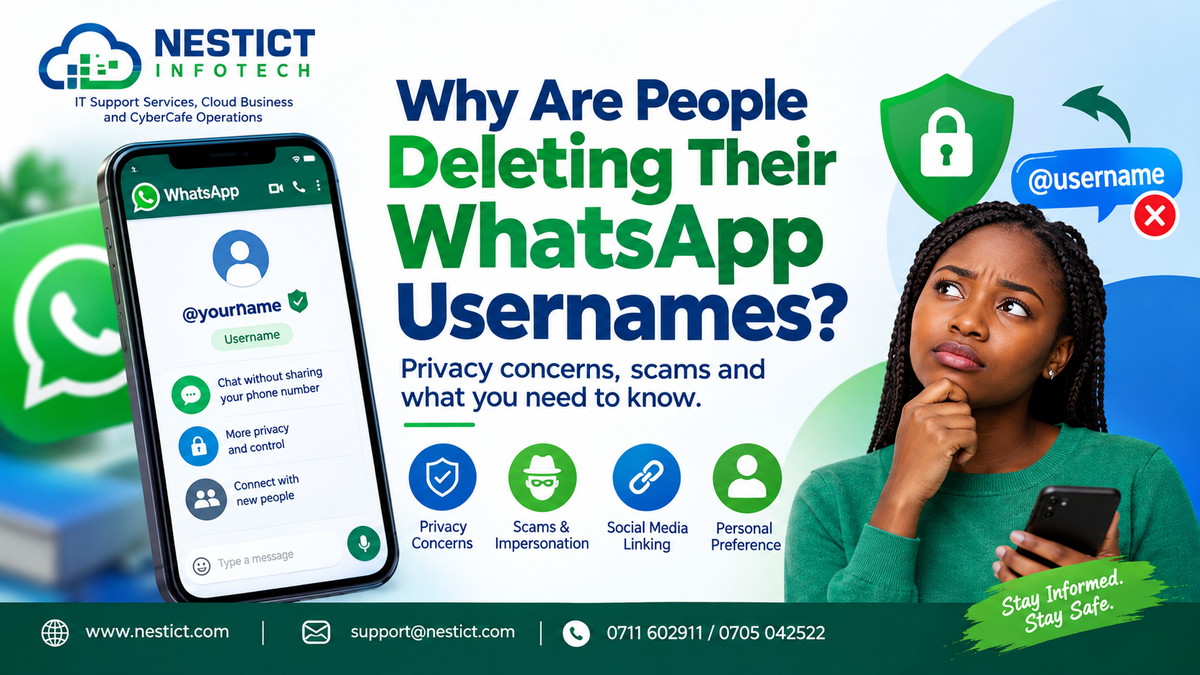
Why Are People Deleting Their WhatsApp Usernames? Privacy Concerns, Scams and What You Need to Know

Introduction: WhatsApp Usernames Are Creating a Privacy Debate
WhatsApp has traditionally relied on phone numbers to identify users. However, its introduction of usernames is changing how people can connect, share contact details and protect their personal information.
The feature offers an important benefit: people can communicate with new contacts without necessarily revealing their phone numbers. This can be useful when joining online communities, participating in group discussions, contacting businesses or meeting people through the internet.
Yet not everyone is convinced that usernames are an improvement.
Some users have expressed concerns about receiving unsolicited messages, being impersonated by fake accounts, linking their identities across social media platforms and making it easier for strangers to contact them. Others simply prefer WhatsApp's traditional phone-number-based approach.
These concerns have prompted an important question: Why are some people reconsidering their WhatsApp usernames, and is deleting one actually the safest option?
The answer depends on how you use WhatsApp, whom you communicate with and what you want to protect.
Importantly, there is no verified evidence establishing a widespread, platform-wide trend of people deleting their usernames. The available reporting and public discussions instead reveal a mix of privacy concerns, security questions and personal preferences.
1. Fear of Unwanted Messages and Spam
One of the biggest concerns surrounding WhatsApp usernames is the possibility of receiving messages from people you do not know.
A username gives users another way to initiate conversations without first exchanging telephone numbers. While WhatsApp says it does not provide a public, searchable username directory, someone who knows your exact username can use it to start a conversation.
This changes the way people think about their online availability.
For example, imagine sharing your username in a public Facebook group, an online marketplace or a community forum. Someone could copy it and contact you on WhatsApp without having your phone number.
If that username is widely shared, it may become harder to control who attempts to contact you.
This does not mean that every username will attract spam. However, people who prefer communicating only with known contacts may find the additional contact method unnecessary.
What users can do: Choose a username that is not easily guessed, avoid publishing it unnecessarily and use WhatsApp's available privacy and blocking controls.
2. Concerns About Scammers and Fake Identities
Another reason people are questioning usernames is the risk of impersonation.
A username can resemble the name of a real person, company, bank, government agency or public figure. A fraudulent account may use a convincing handle to appear legitimate.
For instance, a scammer could create a username resembling a company's customer support identity and send messages requesting payments, passwords or verification codes.
This is especially concerning for businesses and individuals who use WhatsApp to communicate with customers, suppliers or clients.
In July 2026, TechCrunch reported concerns about potentially misleading WhatsApp usernames, including handles resembling prominent people and institutions. The issue also attracted regulatory scrutiny in India, where authorities raised concerns about fraud, phishing and impersonation.
These reports demonstrate a genuine security challenge, although they do not establish that username-related scams are affecting all WhatsApp users.
What users can do: Verify a person's identity independently, be suspicious of unexpected payment requests and never share one-time passwords or account verification codes.
A familiar-looking username is not proof that an account belongs to the person or organisation it claims to represent.
3. Some Users Prefer Not to Be Discoverable
For many people, WhatsApp is a personal communication tool rather than a public social network.
They use it to speak with relatives, friends, colleagues and established business contacts. They may not want to introduce another identifier that can be circulated online.
A username can become a persistent contact identity, particularly when it is reused across multiple platforms or included in public profiles.
This creates a distinction between having an account and making that account easier for new people to contact.
Consider someone who uses WhatsApp for family communication but also participates in public online discussions. They may want to keep these activities separate.
The concern is not necessarily that usernames are inherently unsafe. Instead, the user may prefer a smaller digital footprint and a more controlled way of sharing contact information.
What users can do: Keep personal and professional identities separate, use a unique username where appropriate and avoid placing personal details in a public-facing handle.
4. Linking WhatsApp Identity With Facebook or Instagram
WhatsApp's username rollout also raises questions about the relationship between different social media identities.
Meta has offered eligible creators, businesses and organisations a way to claim an existing Facebook or Instagram username on WhatsApp. This can make it easier to maintain a consistent online identity.
For businesses, that consistency can be useful. Customers may find an organisation more easily when its social media names match.
For privacy-conscious individuals, however, using the same handle across several platforms can make it easier for others to connect separate online profiles.
For example, a person might use one account for professional networking, another for entertainment and WhatsApp for private conversations. Reusing the same username can create a link between these otherwise separate identities.
That link does not automatically mean that private messages become public or that every account detail is exposed. It does mean that people may be able to identify the same person more easily across services.
What users can do: Consider using a distinct WhatsApp username rather than automatically reusing a public social media handle. Do not link identities simply because the option is available.
5. Questions About Privacy and Anonymity
A username can hide a phone number from new contacts, but it does not make someone completely anonymous.
WhatsApp still requires a phone number to register an account. People who already have your number may continue to know it, and your display name and other profile information may still reveal something about your identity.
Users also need to understand that hiding a phone number from another person is different from hiding all account information from the platform itself.
This distinction matters because privacy has several dimensions:
- Contact privacy: Whether another person can see your telephone number.
- Identity privacy: Whether your username or profile reveals who you are.
- Message privacy: Whether your communications are protected against unauthorised access.
- Account security: Whether someone can take over your account or impersonate you.
A username primarily changes how people can identify and contact you. It should not be treated as a complete privacy or security solution.
6. Some People Simply Prefer Phone Numbers
Not every decision to avoid a username is driven by fear.
Some users are comfortable sharing their phone numbers with people they know and do not see a strong reason to adopt another identifier.
In many communities, including Kenya, phone numbers are already widely used for calls, business enquiries and mobile payments. People may prefer the familiarity of exchanging a number rather than explaining how to find or use a username.
Businesses may also have established customer contact processes based on telephone numbers, WhatsApp Business profiles and existing contact lists.
For these users, usernames may be convenient in some situations but unnecessary in others.
The key point is that WhatsApp usernames are optional. Users can decide whether the feature fits their communication habits.
7. Does Deleting a WhatsApp Username Actually Improve Privacy?
This is where users need to be especially careful.
According to the WhatsApp Help Center, usernames can be changed or deleted. However, deleting a username can make your phone number visible again to people who previously interacted with you through the username-based contact arrangement.
In other words, removing a username may undo one of the feature's principal privacy benefits: keeping your phone number from new contacts.
The decision therefore involves a trade-off.
Keeping a username may be preferable if:
- You regularly communicate with people you do not know personally.
- You operate a business or provide customer support.
- You want to avoid distributing your personal phone number.
- You can manage your username and contact information carefully.
Avoiding or deleting a username may suit you if:
- You do not need username-based contact.
- You prefer the traditional phone-number-based approach.
- You want to minimise the number of public identifiers you maintain.
- You understand the consequences of deleting the username and are comfortable with them.
Neither choice guarantees complete privacy. The right decision depends on the specific risks you are trying to reduce.
Before deleting your username, review WhatsApp's current guidance and consider who may be able to see your number afterwards.
8. How to Protect Your WhatsApp Account Without Deleting Your Username
If your concern is security rather than the username itself, several precautions can help.
Use a username that does not reveal too much
Avoid handles that contain your full name, date of birth, workplace, telephone number or other information that makes your identity easy to establish.
A unique username can also make it harder for someone to connect your WhatsApp profile with unrelated public accounts.
Consider WhatsApp's username key
WhatsApp provides an optional username key that adds another layer of control over who can contact you through your username. When enabled, someone who wants to initiate a new username-based conversation must know the required key.
Review the current feature settings to understand which contacts are affected by this requirement.
Enable two-step verification
Two-step verification adds a PIN requirement to help protect your account. Use an email address you control for recovery where supported, and never share your PIN or verification codes with another person.
Be careful with suspicious links
Messages claiming that you must urgently verify your username, reserve an account through an unfamiliar website or pay a fee to prevent account suspension should be treated cautiously.
Open WhatsApp directly to inspect your settings instead of following an unexpected link.
Block and report suspicious accounts
If someone sends threatening messages, attempts impersonation or repeatedly contacts you without permission, use the platform's blocking and reporting options.
Review your privacy settings
Check who can see your profile photo, About information, Status updates and other profile details. Restrict visibility where appropriate.
These measures address several practical risks without automatically requiring you to delete your username.
9. What Does This Mean for WhatsApp Users in Kenya?
For Kenyan individuals, businesses, students and online entrepreneurs, usernames could make it easier to connect without immediately sharing a personal phone number.
This may be particularly helpful when advertising products online, participating in professional groups or communicating with customers who have not previously interacted with a business.
However, the same convenience requires sensible precautions.
A business should make its official contact details easy to verify. Customers should not assume that a familiar username is genuine, particularly when a message requests money or sensitive information.
Individuals should also be careful about sharing usernames publicly and should avoid using the same identity everywhere if they want to keep personal and professional activities separate.
For businesses using WhatsApp for customer support, it is worth establishing clear procedures for verifying payments, confirming customer identities and handling suspicious messages.
The objective is not to reject new technology. It is to understand its limitations and use it appropriately.
10. Are People Deleting WhatsApp Usernames Because They Are Unsafe?
The evidence does not support a simple yes-or-no conclusion.
Public discussions show that some users are uncomfortable with the change, while others welcome the ability to communicate without disclosing their phone numbers. Technology reporting has also highlighted legitimate concerns about impersonation and fraudulent accounts.
However, individual comments and news reports about potential risks cannot establish how many people are deleting their usernames.
It would therefore be misleading to claim that WhatsApp is experiencing a mass deletion trend without reliable usage statistics or other representative evidence.
A more defensible conclusion is that the rollout has prompted a debate about the balance between privacy, convenience and accountability.
The feature offers a way to limit phone-number exposure, but it also creates new questions about identity verification and unwanted contact. Users are evaluating those trade-offs according to their own needs.
Conclusion: Think Before You Delete Your WhatsApp Username
WhatsApp usernames are neither automatically dangerous nor a complete solution to digital privacy.
They can help people communicate without revealing their phone numbers, but public identifiers may also create concerns about spam, impersonation and linking identities across social media.
For some users, avoiding a username is a reasonable personal preference. For others, keeping one may provide a useful layer of contact privacy.
The important thing is to understand what the feature does and what happens when it is removed.
Before deleting your WhatsApp username, ask yourself one question: Am I trying to prevent strangers from seeing my phone number, or am I trying to prevent strangers from contacting me?
Those are different problems, and they may require different solutions.
Rather than following a trend or reacting to an alarming social media post, review the official WhatsApp guidance, assess your own circumstances and choose the settings that best protect your privacy.
Frequently Asked Questions (FAQs)
Can I delete my WhatsApp username?
Yes. WhatsApp's Help Center states that users can change or delete their usernames. Review the current in-app settings before making changes.
Will deleting my WhatsApp username hide my phone number?
No. Deleting the username can make your phone number visible again to people who previously interacted with you through the username-based arrangement.
Can strangers find me by searching for my WhatsApp username?
WhatsApp says it does not offer a public, searchable username directory. Someone generally needs to know your exact username to initiate a new conversation through it.
Are WhatsApp usernames safe?
They can improve contact privacy by reducing the need to share phone numbers. However, users should still consider impersonation, unwanted messages and account-security risks.
Can someone hack my WhatsApp account using my username?
A username alone does not automatically give someone access to your account. However, scammers may use usernames to impersonate people or initiate phishing attempts. Never share verification codes or two-step verification PINs.
Should I use the same username on WhatsApp, Facebook and Instagram?
That depends on your goals. Consistent usernames can help businesses and creators maintain a recognisable identity, while separate usernames may help individuals keep different online activities apart.
Should I delete my WhatsApp username?
There is no universal answer. If you want to avoid sharing your phone number with new contacts, retaining a username may be useful. If you do not need the feature, you can choose not to use it, but understand the implications of deleting it.
Sources and further reading
- WhatsApp Help Center — About usernames: https://faq.whatsapp.com/658755553162769/
- WhatsApp Blog — It's time to reserve your WhatsApp username: https://blog.whatsapp.com/its-time-to-reserve-your-whatsapp-username
- TechCrunch — WhatsApp usernames are already raising impersonation red flags: https://techcrunch.com/2026/07/01/whatsapp-usernames-are-already-raising-impersonation-red-flags/
- Reuters — India tells WhatsApp to halt usernames rollout, justify feature or face action: https://www.reuters.com/world/india/india-asks-whatsapp-hold-usernames-rollout-pending-consultations-letter-shows-2026-07-01/
Editorial note: The article distinguishes reported security concerns and individual user opinions from verified evidence of a broad deletion trend. Update it if WhatsApp publishes reliable adoption or deletion statistics.