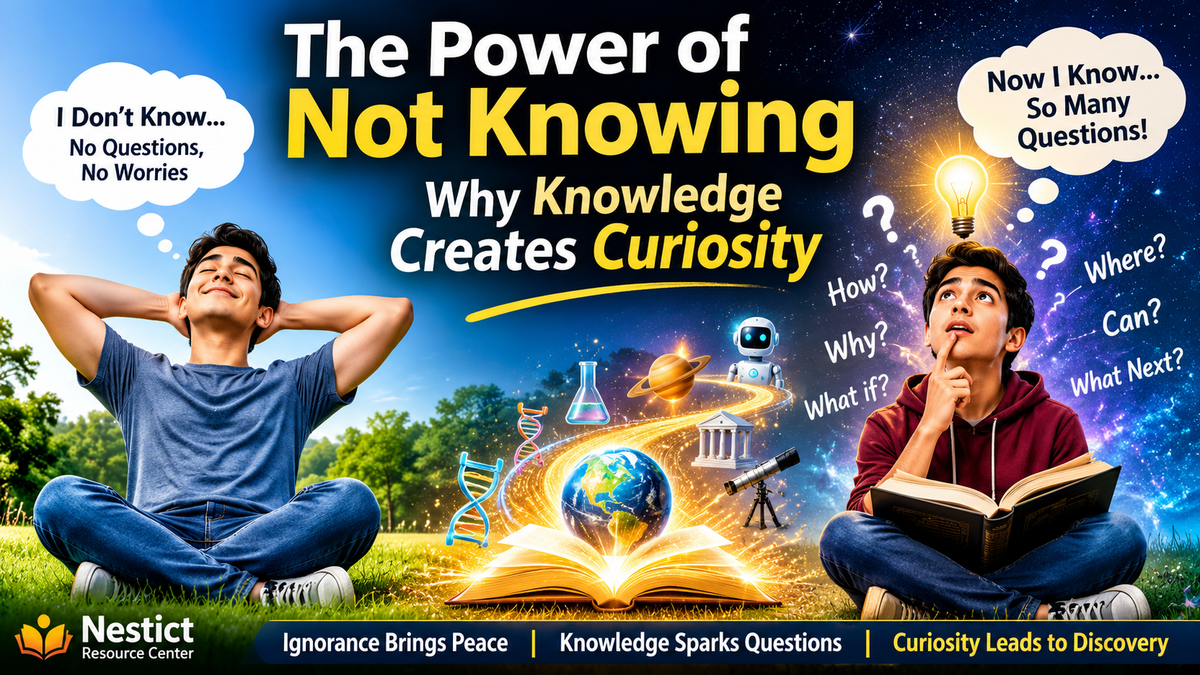
The Power of Not Knowing: Why Ignorance Creates No Questions, but Knowledge Awakens Curiosity

Introduction: The Paradox of Knowing and Not Knowing
Have you ever wondered why a person who knows nothing about a particular subject may appear completely comfortable, while another person who discovers just a little about that same subject suddenly develops hundreds of questions?
Why does someone who has never heard about a particular technology live without worrying about how it works, yet someone who discovers its capabilities becomes interested in understanding its architecture, applications, limitations and future?
Why can a person walk past an unfamiliar building without giving it a second thought, but once told that the building contains something extraordinary, become curious about what is inside?
This introduces an interesting philosophical proposition:
The power of not knowing creates no immediate curiosity about what is unknown, while the power of knowing creates curiosity about what remains undiscovered.
Not knowing does not necessarily mean that something is harmless. It means that the mind may not yet have the information, awareness or reference point needed to recognise a question.
Knowledge changes that condition.
It introduces new possibilities, reveals contradictions, exposes limitations and creates awareness of things that were previously outside our imagination.
In simple terms:
- Before knowing, we may not recognise what is missing.
- After knowing, we begin to recognise what we do not understand.
- When we recognise what we do not understand, curiosity emerges.
- When curiosity grows, we begin searching for more knowledge.
This is one of the fascinating cycles of human intellectual development.
1. The Power of Not Knowing: When the Unknown Does Not Demand Attention
Imagine two people.
Person A has never heard about artificial intelligence.
Person B has recently discovered artificial intelligence and understands that machines can analyse information, generate content, recognise patterns and assist with complex tasks.
Person A may continue with everyday activities without wondering how artificial intelligence works.
Person B, however, may begin asking:
- How does artificial intelligence learn?
- Can machines think?
- Where does the information come from?
- Can AI replace human workers?
- Who controls artificial intelligence?
- What happens when machines become more intelligent?
- Can machines understand emotions?
The difference is not necessarily intelligence. It is awareness.
Person A has no immediate reason to investigate a subject that has not entered their field of awareness.
Person B has acquired enough information to recognise additional questions.
Illustration 1: The awareness boundary
Consider the following conceptual illustration:
Before knowledge
Unknown subject → No recognised information gap → Little or no subject-specific curiosity.
After knowledge
Initial discovery → Awareness → Recognition of unanswered questions → Curiosity → Investigation.
The important distinction is that the unknown may exist without becoming a conscious concern.
This does not mean that people who know less are happier or that ignorance is always beneficial. It means that awareness influences what the mind considers worth investigating.
2. The First Derived Theory: The Awareness-Curiosity Principle
We can derive an original conceptual principle from this observation.
The Awareness-Curiosity Principle:
Curiosity begins when awareness reveals the existence of something that the mind does not yet fully understand.
The principle suggests that curiosity requires more than an absence of knowledge. It requires recognition of that absence.
For example, a child who has never seen an aeroplane may not ask how jet engines operate.
After seeing an aeroplane flying above their home, the child may ask:
- How does something so heavy remain in the air?
- Where does the fuel go?
- How does the pilot control it?
- Why does it not fall?
The experience creates awareness, and awareness generates questions.
The child has not yet acquired aviation knowledge, but has acquired something equally important: the desire to acquire it.
This explains why exposure, observation, education and experience are powerful foundations for learning.
3. Knowledge Does Not Always End Ignorance; Sometimes It Expands It
One of the greatest misconceptions about knowledge is that learning something makes a person feel that they know everything.
In reality, meaningful learning often reveals how much remains unknown.
Consider someone who begins studying the human brain.
Initially, they may believe that understanding the basic functions of the brain is sufficient.
But as they learn more, they encounter:
- Neurons and electrical signalling.
- Memory formation.
- Consciousness.
- Emotional regulation.
- Neuroplasticity.
- Dreams.
- Language processing.
- The relationship between the brain and the body.
Each discovery introduces additional questions.
The learner becomes more knowledgeable, but simultaneously becomes more aware of the complexity of the subject.
This creates a paradox:
The more we understand, the more accurately we can recognise the limits of our understanding.
Illustration 2: The expanding circle of knowledge
Imagine knowledge as a circle.
Inside the circle is what a person understands.
Outside the circle is everything that remains unexplored.
When the circle expands, its boundary also expands.
A larger boundary exposes more points of contact with the unknown.
Conceptually:
- Small knowledge circle: Limited awareness of unanswered questions.
- Growing knowledge circle: More discoveries and more questions.
- Advanced knowledge circle: Greater understanding of complexity and uncertainty.
This is why highly knowledgeable individuals can sometimes be more comfortable saying, "I do not know," than people who have only encountered a small portion of a subject.
They understand the scale of what remains to be discovered.
4. The Second Derived Theory: The Expanding Knowledge Boundary Theory
This article proposes another conceptual framework:
The Expanding Knowledge Boundary Theory:
Every meaningful increase in knowledge can expand both the territory of understanding and the boundary of unanswered questions.
Imagine knowledge as an expanding geographical territory.
When a person discovers a new territory, they do not merely acquire the land they have explored. They also discover neighbouring territories that they have not yet visited.
The same happens intellectually.
Learning about computers introduces programming.
Programming introduces algorithms.
Algorithms introduce computational complexity.
Computational complexity introduces questions about efficiency, optimisation and the limits of computation.
One subject becomes the entrance to several others.
Knowledge therefore has two simultaneous effects:
- It reduces certain forms of ignorance.
- It reveals additional forms of ignorance.
The second effect is not a failure of learning. It is evidence that learning has progressed.
5. The Third Derived Theory: The Curiosity Activation Gap
Why do some discoveries make us curious while others leave us uninterested?
Consider these two situations:
Situation A: Someone tells you that there is an object somewhere in the universe that you have never encountered, but provides no further information.
You may have little interest because you have no reference point.
Situation B: Someone shows you an image of an unusual object, explains one surprising feature and then leaves an unanswered question.
You may immediately want to know more.
The difference is the presence of a meaningful information gap.
This idea has a connection with George Loewenstein's Information-Gap Theory of Curiosity, which explains curiosity as arising when people recognise a gap between what they currently know and what they want to know.
The theory was presented in his 1994 paper, The Psychology of Curiosity: A Review and Reinterpretation.
The implication is fascinating: complete unfamiliarity does not always generate strong curiosity. Sometimes, a little information is necessary before a person can recognise what is missing.
A conceptual curiosity formula
We can represent the idea using a simple illustrative model:
Curiosity = Awareness × Perceived Knowledge Gap × Relevance
This is not a scientifically validated mathematical formula. It is a conceptual framework for explaining the relationship.
- Awareness makes the subject noticeable.
- The knowledge gap creates unanswered questions.
- Relevance gives the questions personal or practical importance.
If a person is unaware of a subject, the curiosity activation process may not begin.
If the subject is already fully understood, the immediate knowledge gap may be small.
If the subject is unfamiliar and has no perceived relevance, interest may remain limited.
Curiosity often becomes strongest when a person knows enough to recognise that something important is missing.
6. The Fourth Derived Theory: The Burden of Awareness
Knowledge is not always comfortable.
Sometimes, learning something changes how we perceive people, institutions, relationships, businesses and society.
Consider a person who has never examined how a business operates.
They may believe that a company simply sells products and receives money.
After learning about business operations, they discover:
- Cash flow management.
- Tax obligations.
- Employee costs.
- Inventory management.
- Customer acquisition.
- Compliance.
- Business risks.
- Financial reporting.
Their understanding becomes more realistic.
However, their responsibilities and concerns may also increase.
The same principle applies to personal relationships.
A person who does not understand how communication affects relationships may interpret silence as normal.
After learning about emotional intelligence, communication patterns and conflict resolution, they may begin questioning previously accepted behaviours.
Awareness creates new expectations.
This leads to the proposed:
Burden of Awareness Principle:
Knowledge can increase responsibility because understanding a problem makes it harder to justify ignoring it.
Consider the difference:
Not knowing about a security vulnerability may leave a system administrator unaware of a particular risk.
Discovering the vulnerability creates an obligation to investigate and potentially address it.
Not knowing about financial mismanagement may allow an organisation to continue operating without recognising the problem.
Discovering it creates a responsibility to examine the records and take appropriate action.
Knowledge therefore does not simply provide information. It can introduce decisions, duties and accountability.
7. The Fifth Derived Theory: The Irreversibility of Discovery
There is an interesting difference between forgetting a fact and never having discovered it.
Imagine that you have never seen how a traditional clock works.
You may look at its face and understand that the hands indicate time.
One day, someone opens the clock and explains its internal mechanism.
You discover the gears, springs and movement.
From that moment, whenever you see the same clock, you may remember that an entire mechanical system exists behind its face.
Your perception has changed.
You cannot easily return to your original understanding of the clock.
This leads to another conceptual theory:
The Irreversibility of Discovery Principle:
Once meaningful information becomes part of a person's awareness, it can permanently alter the way that person interprets related experiences.
Examples include:
- Learning how photographs can be manipulated changes how you evaluate images.
- Learning how advertising works changes how you interpret marketing.
- Learning how misinformation spreads changes how you evaluate rumours.
- Learning how computer networks operate changes how you perceive internet services.
- Learning how financial interest accumulates changes how you evaluate borrowing.
Knowledge changes the lens through which reality is interpreted.
However, this does not mean that every piece of information is permanent or that people cannot revise incorrect beliefs. New evidence can change our understanding again.
8. The Sixth Derived Theory: The Curiosity Expansion Cycle
Knowledge and curiosity can create a continuous feedback relationship.
The process can be illustrated as follows:
Stage 1: Unawareness
A person does not recognise a subject or its significance.
Stage 2: Exposure
The person encounters new information.
Stage 3: Initial Understanding
The person acquires enough knowledge to recognise the subject.
Stage 4: Question Formation
The person begins identifying missing information.
Stage 5: Curiosity
The desire to understand becomes stronger.
Stage 6: Investigation
The person reads, observes, experiments, asks questions or researches.
Stage 7: New Knowledge
The person acquires additional understanding.
Stage 8: New Unknowns
The new understanding reveals further unanswered questions.
The cycle begins again.
Illustration 3: The knowledge-curiosity cycle
UNAWareness
↓
EXPOSURE
↓
INITIAL KNOWLEDGE
↓
RECOGNITION OF GAPS
↓
CURIOSITY
↓
INVESTIGATION
↓
NEW KNOWLEDGE
↓
NEW QUESTIONS
↓
FURTHER DISCOVERY
This cycle is central to education, research, innovation, entrepreneurship and scientific development.
It explains why learning should not be treated as the mere collection of facts.
Learning should develop the ability to ask better questions.
9. The Dangerous Side of Knowing: When Curiosity Becomes Anxiety
Although knowledge can be empowering, it can also introduce anxiety.
Consider someone who has never worried about the security of their personal information.
After learning about cybercrime, identity theft, phishing and data breaches, they may become suspicious of every message they receive.
Their awareness has increased, but so has their perception of risk.
The same can happen with:
- Financial markets.
- Political developments.
- Health information.
- Technology.
- Relationships.
- Social media.
- Business competition.
This demonstrates that curiosity must be accompanied by critical thinking.
Knowing about a possible danger does not mean that the danger is necessarily present.
Understanding a risk requires evaluating its probability, evidence and potential consequences.
There is a difference between being informed and being overwhelmed.
Knowledge should improve our ability to make decisions, not simply increase the number of things we fear.
10. Knowing Can Create Both Wisdom and Arrogance
Another important distinction is that knowledge does not automatically produce wisdom.
A person may know many facts but lack the ability to apply them appropriately.
Someone may understand business theory but fail to manage a business.
Someone may understand human psychology but misuse that knowledge to manipulate others.
Someone may understand technology but fail to appreciate its social consequences.
This gives us three distinct concepts:
Information: Knowing that something exists.
Knowledge: Understanding how or why something works.
Wisdom: Knowing how to apply that understanding responsibly.
For example:
Knowing that fire burns is information.
Understanding combustion is knowledge.
Knowing when and how to use fire safely is wisdom.
Curiosity helps people move from information towards knowledge, but judgment and experience are also required to develop wisdom.
11. Application in Education: Why Children Must Be Encouraged to Ask Questions
Traditional learning environments sometimes place greater emphasis on remembering answers than developing questions.
However, curiosity is an important driver of learning.
A student who memorises the definition of electricity may pass an examination.
A student who asks why electricity flows, how circuits operate and how electrical energy is transformed may develop a deeper understanding.
The difference is the movement from passive information reception to active intellectual investigation.
Teachers and parents should therefore encourage questions such as:
- Why does this happen?
- What would happen if we changed one condition?
- Can we prove this explanation?
- Is there another possible explanation?
- How can we apply this knowledge?
- What do we still not understand?
The objective is not to make students question everything without direction.
It is to develop disciplined curiosity.
A good education should not merely teach people what is known. It should help them recognise what is not yet known.
12. Application in Technology: Discovery Creates New Possibilities
Technology provides some of the clearest examples of this phenomenon.
Before computers became widely accessible, many people had little reason to imagine the possibilities of digital information processing.
After discovering computers, people began exploring:
- Programming.
- Networking.
- Databases.
- Websites.
- Cloud computing.
- Artificial intelligence.
- Cybersecurity.
- Automation.
- Digital commerce.
Each technological development creates new questions and opportunities.
A person who discovers website development may become curious about databases.
Database knowledge may create curiosity about cloud infrastructure.
Cloud infrastructure may introduce questions about cybersecurity, scaling and distributed systems.
The knowledge journey becomes increasingly interconnected.
This is one reason innovation often emerges from people who combine knowledge from different disciplines.
The next discovery may come from a question that another person has never thought to ask.
13. Application in Business: The Danger of Not Knowing What You Do Not Know
In business, ignorance can sometimes appear less demanding than awareness.
An entrepreneur who has never studied financial management may not worry about profit margins, working capital or cash-flow forecasting.
But once the entrepreneur understands these concepts, they may begin reviewing every financial decision.
This is not necessarily a disadvantage.
It is the beginning of informed management.
Consider two business owners:
Business Owner A
- Does not monitor stock movement.
- Does not calculate customer acquisition costs.
- Does not examine operating expenses.
- Relies on general impressions.
Business Owner B
- Monitors inventory.
- Examines sales performance.
- Understands cash flow.
- Investigates operational inefficiencies.
- Identifies opportunities for automation.
Business Owner B may experience more questions and more responsibilities, but also has better tools for making informed decisions.
The lesson is that ignorance can conceal problems, while knowledge can expose opportunities for improvement.
14. Application in Society: Why Information Changes Public Awareness
Societies also experience the transition from unawareness to curiosity.
A community may live with a particular problem for years without understanding its causes.
Once people receive relevant information, they may begin asking:
- Why does the problem continue?
- Who is responsible?
- What does the law provide?
- What resources are available?
- What solutions have worked elsewhere?
- How can citizens participate in solving it?
This can apply to environmental conservation, public infrastructure, digital literacy, governance, education and economic development.
However, there is an important warning.
Information without verification can produce misinformation.
Curiosity without critical thinking can produce speculation.
Awareness without responsible action can produce frustration.
Therefore, knowledge must be supported by evidence, reliable sources and constructive engagement.
15. The Final Derived Theory: The Knowledge Responsibility Principle
We can bring the preceding arguments together through one final conceptual principle.
The Knowledge Responsibility Principle:
As an individual's understanding of a subject increases, their capacity to recognise its consequences and make informed decisions may also increase.
This does not mean that every person who knows something must solve every problem associated with it.
It means that knowledge provides an opportunity to act more intelligently.
A person who understands the consequences of environmental pollution can make better disposal decisions.
A person who understands cybersecurity can take precautions against digital threats.
A person who understands financial planning can make more informed financial decisions.
A person who understands misinformation can become more careful about sharing unverified claims.
Knowledge creates an opportunity for responsible action.
Whether that opportunity is used wisely depends on character, resources, judgment and circumstances.
16. A Philosophical Comparison: The World Before and After Knowing
Consider the following comparison:
| Before knowing | After knowing |
|---|---|
| No recognised question | Questions emerge |
| Limited awareness | Expanded awareness |
| Familiar assumptions | New perspectives |
| Little perceived uncertainty | Recognition of uncertainty |
| Passive observation | Active investigation |
| Fewer perceived possibilities | More imagined possibilities |
| Unrecognised responsibility | Greater awareness of consequences |
The comparison does not suggest that the left side is always better or worse.
Rather, it illustrates how knowledge changes our relationship with the world.
The unknown is not necessarily empty.
It may contain opportunities, risks, explanations and possibilities that have not yet entered our awareness.
17. A Thought Experiment: What If Human Beings Knew Everything?
Imagine a world in which every human being possessed complete knowledge of everything.
There would be no unanswered scientific questions.
No unknown historical events.
No undiscovered technologies.
No mysteries about the universe.
No unanswered questions about human existence.
Would curiosity disappear?
If all relevant questions had already been answered, the traditional desire to discover missing information would have little room to operate.
But would humans stop creating, exploring and experiencing?
Not necessarily.
New experiences, changing environments and new decisions could still create fresh questions.
The thought experiment helps us understand that curiosity is connected not only to the amount of information we possess but also to the existence of meaningful possibilities that remain unexplored.
Perhaps the beauty of human intelligence is not that we can know everything.
It is that we can continually discover that there is more to understand.
18. Conclusion: Not Knowing Is a State; Knowing Is an Invitation
The power of not knowing is that an undiscovered question may not yet demand our attention.
The power of knowing is that every discovery can introduce a new way of seeing the world.
We begin by learning something small.
That small discovery changes our perspective.
Our new perspective reveals unanswered questions.
Those questions generate curiosity.
Curiosity encourages investigation.
Investigation produces knowledge.
And knowledge reveals further possibilities.
This is the intellectual journey of humanity.
However, we must distinguish between ignorance and innocence, between curiosity and obsession, and between knowledge and wisdom.
Not knowing does not guarantee peace.
Knowing does not guarantee happiness.
But understanding gives us more opportunities to make informed choices.
Perhaps the greatest intellectual achievement is not reaching a point where we believe we know everything.
It is reaching a point where we understand enough to appreciate how much remains unknown.
The greatest power of knowledge is not the answers it gives us, but the quality of questions it teaches us to ask.
A Final Question for the Reader
If a person does not know what they are missing, are they truly missing it in their own experience?
And if discovering something creates ten new questions, has that person become more confused, or have they simply become more intellectually aware?
Perhaps knowledge does not eliminate the unknown.
Perhaps it teaches us how to recognise it.
What do you think: Is ignorance a form of peace, or is curiosity the price we pay for becoming aware?
Share your thoughts and join the discussion at the Nestict Resource Center.
NESTICT INFOTECH
Website: https://www.nestict.com
Resource Center: https://www.blog.nestict.com/
Research and Intellectual Foundations
The philosophical frameworks introduced in this article are original conceptual interpretations, not established scientific laws. They draw inspiration from established research on curiosity and knowledge.
- George Loewenstein (1994). The Psychology of Curiosity: A Review and Reinterpretation. Psychological Bulletin, 116(1), 75–98. DOI: https://doi.org/10.1037/0033-2909.116.1.75
- Russell Golman and George Loewenstein (2014). Curiosity, Information Gaps, and the Utility of Knowledge. A framework examining why people seek or avoid information.
- Ten, A., Oudeyer, P.-Y., Sakaki, M., and Murayama, K. (2025). The Curious U: Integrating Theories Linking Knowledge and Information-Seeking Behavior. Open Mind, 9, 1763–1785. DOI: https://doi.org/10.1162/OPMI.a.41