Superiority Complex: When Feeling "Above Others" Hides Something Deeper

Introduction
Imagine a tree that stretches far above the forest, constantly proclaiming itself the tallest. From a distance it appears powerful and untouchable. Yet beneath the soil, its roots are surprisingly shallow, relying on constant support to remain standing.
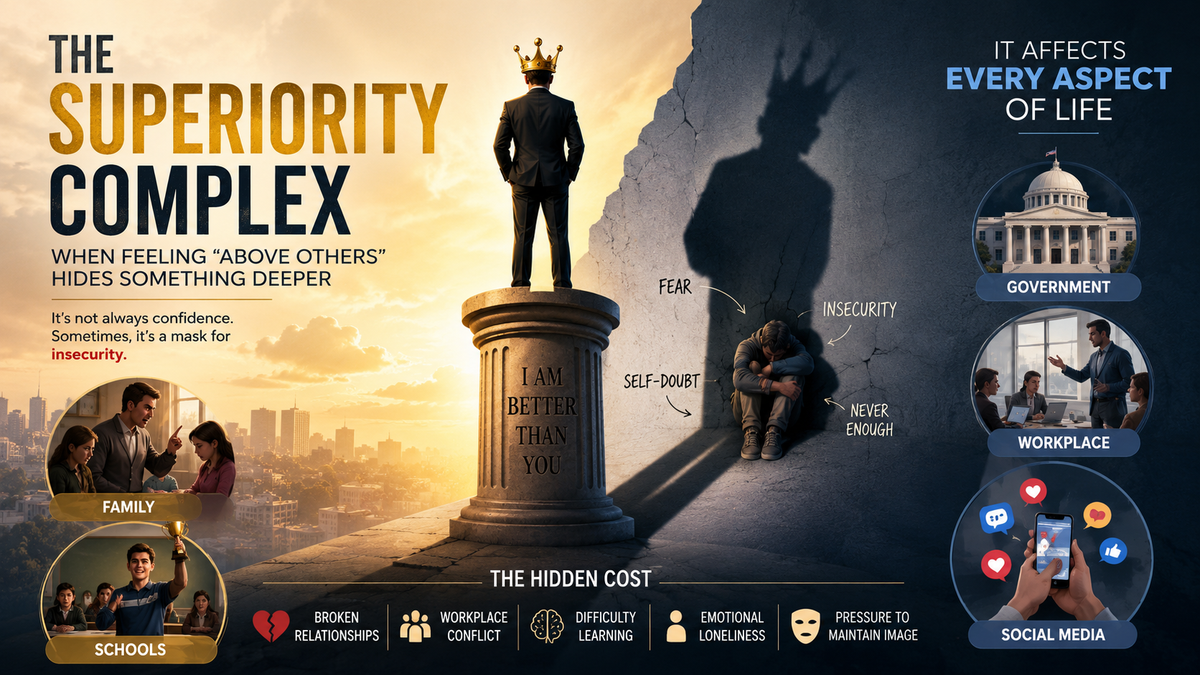
A superiority complex often works in much the same way. What appears to be extraordinary confidence can sometimes be a shield protecting hidden insecurity, fear, or self-doubt.
Contrary to popular belief, people with a superiority complex are not always genuinely convinced of their greatness. In many cases, they have learned to mask vulnerability by projecting strength, dominance, or perfection.

🖼️ Illustration 1: The Mask
Suggested Illustration
A person wearing a golden crown and standing on a pedestal while holding a smiling mask. Behind the mask is an anxious face looking into a cracked mirror.
Caption: Confidence on the outside does not always reflect confidence within.
What Is a Superiority Complex?
The term was introduced by Alfred Adler, who believed that people sometimes overcompensate for feelings of inferiority by presenting themselves as superior to everyone else.
A superiority complex is therefore not simply being confident. It is an exaggerated belief in one's own importance or abilities, often used as a psychological defense mechanism.
Healthy Confidence vs. Superiority Complex
| Healthy Confidence | Superiority Complex |
|---|---|
| Appreciates personal strengths | Exaggerates strengths |
| Accepts mistakes | Refuses to admit mistakes |
| Respects others | Looks down on others |
| Learns from criticism | Rejects criticism |
| Celebrates teamwork | Wants all the credit |
🖼️ Illustration 2: Two Mountains
Suggested Illustration
Two mountains.
- One has many people climbing together with smiles.
- The other has one person standing alone waving a flag while pushing others away.
Caption: Leadership builds others. Superiority isolates.
Common Signs
Someone with a superiority complex may:
👑 Constantly Seek Recognition
Every conversation becomes an opportunity to highlight achievements.
🎭 Belittle Others
They criticize people to make themselves appear more important.
🏆 Always Need to Win
Even ordinary discussions become competitions.
🚫 Reject Advice
Suggestions are interpreted as personal attacks.
⭐ Crave Admiration
Compliments become emotional fuel.
⚔️ Dominate Conversations
Instead of listening, they lecture.
🖼️ Illustration 3: The Conversation Scale
One side shows several people trying to speak.
The other side shows one person talking through a giant megaphone.
Caption: Communication becomes one-sided when superiority replaces curiosity.
Causes
A superiority complex rarely develops overnight.
Common contributing factors include:
Childhood Experiences
- Excessive criticism
- Unrealistic expectations
- Overpraise without accountability
- Emotional neglect
Fear of Failure
Some people believe they must appear perfect because admitting mistakes feels unbearable.
Social Status
Power, wealth, education, or popularity can sometimes encourage feelings of superiority if humility is not maintained.
Low Self-Esteem
Ironically, hidden insecurity is one of the strongest drivers.
🖼️ Illustration 4: Iceberg
Above water:
- Success
- Confidence
- Achievement
- Prestige
Below water:
- Fear
- Rejection
- Self-doubt
- Anxiety
- Insecurity
Caption: What we see is often only the visible part of the story.
Superiority Complex in Everyday Life
🏛️ Governments
Some governments may portray themselves as always correct while dismissing criticism or opposing viewpoints.
👨👩👧 Families
Parents or older siblings may insist:
"Because I said so."
Rather than encouraging discussion, authority becomes unquestionable.
💼 Businesses
Companies sometimes assume competitors have nothing valuable to offer.
This mindset can lead to missed innovation and declining customer trust.
🏫 Schools
A student may constantly remind classmates of higher grades while mocking others.
Eventually, academic success becomes social isolation.
❤️ Relationships
One partner believes they are always right.
Arguments become battles rather than conversations.
🌍 Social Media
Followers, likes, and viral moments can create an illusion of superiority.
Online popularity, however, is not the same as emotional maturity.
🖼️ Illustration 5: Social Media Throne
A person sits on a throne built from "Likes" while real friendships below slowly fade into grayscale.
Caption: Digital applause cannot replace genuine human connection.
The Hidden Cost
Living with a superiority complex often results in:
- Broken friendships
- Workplace conflict
- Difficulty learning new skills
- Poor teamwork
- Emotional loneliness
- Constant pressure to maintain a flawless image
The higher the pedestal, the farther the fall feels.
Can It Be Changed?
Yes.
Growth begins when someone develops enough self-awareness to ask:
- Why do I always need to prove myself?
- Why does criticism hurt so much?
- Why do I compare myself with everyone?
Practical steps include:
- Practicing active listening
- Accepting mistakes gracefully
- Appreciating others' achievements
- Asking for feedback
- Developing empathy
- Seeking professional support if needed
Humility does not reduce greatness. It strengthens it.
🖼️ Illustration 6: Building Bridges
Two people remove bricks from separate walls and use them to build a bridge across a river.
Caption: Humility transforms barriers into connections.
========================
A superiority complex is less about genuine strength and more about protecting the ego from perceived weakness. While confidence empowers people to grow, superiority often traps them inside a lonely fortress built from comparison.
The strongest individuals are rarely those who insist they are above everyone else. They are the ones who continue learning, admit when they are wrong, and elevate those around them.
Real greatness is measured not by how high we stand above others, but by how many people stand taller because we helped them grow.