Orthodox Psychology vs. Reverse Psychology: The Hidden Dance Behind Everyday Influence

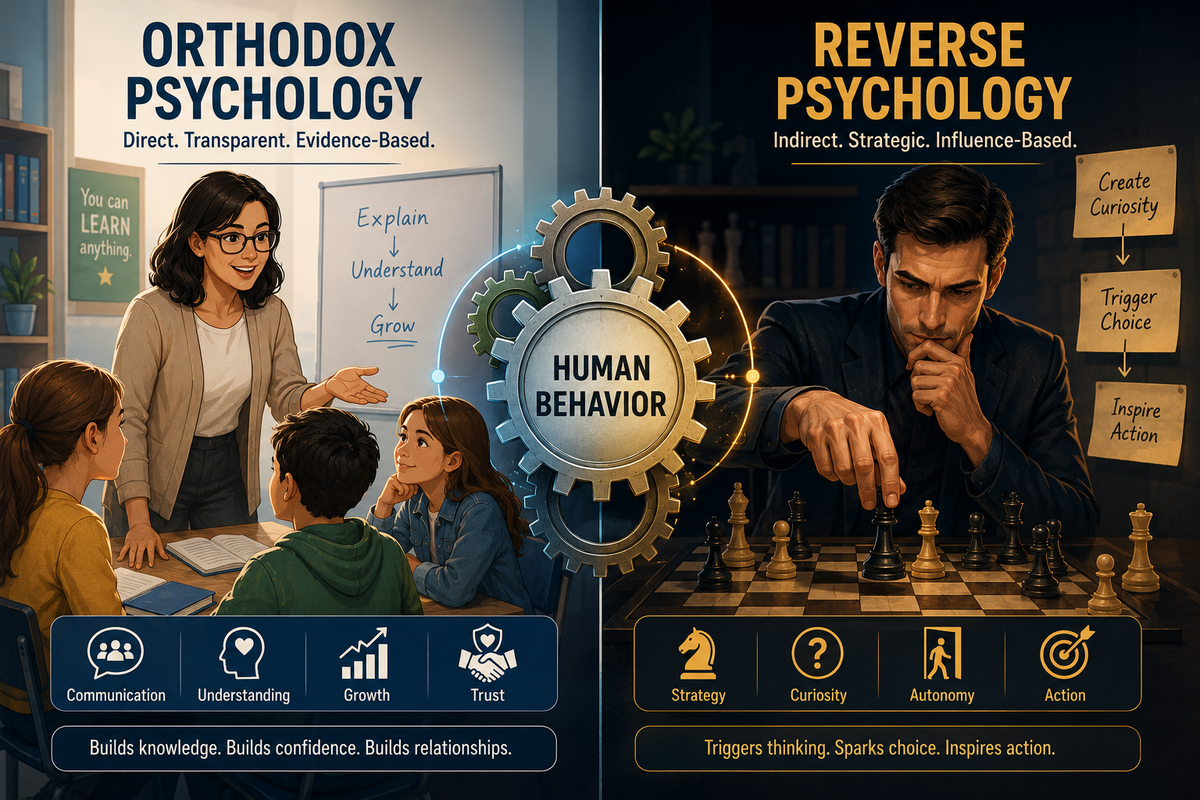
The interesting part is that influence rarely relies on a single method. Instead, it often combines orthodox psychology (direct, evidence-based communication) and reverse psychology (strategic indirect influence).
Introduction
Every day, people influence one another.
Parents encourage children to study.
Governments promote public health.
Businesses persuade customers to buy.
Teachers inspire learning.
Managers motivate employees.
Contrary to popular belief, these approaches are not enemies.
They are complementary tools.
The real question isn't which one is better, but when each is appropriate.
What is Orthodox Psychology?
Orthodox psychology refers to conventional psychological principles supported by research and ethical practice.
Its foundation is built upon:
- Clear communication
- Positive reinforcement
- Emotional intelligence
- Cognitive understanding
- Behavioral science
- Trust building
Rather than manipulating behavior, orthodox psychology seeks to understand why people think and behave as they do.
Core Philosophy
"Explain first. Influence second."
Typical Techniques
- Education
- Counseling
- Rewards
- Coaching
- Cognitive Behavioral Therapy
- Active listening
- Feedback
- Habit formation
Everyday Example
A parent says:
"Please finish your homework because it will help you succeed later."
The child understands the reason.
The influence is transparent.
What is Reverse Psychology?
Reverse psychology is an indirect persuasion strategy.
Instead of requesting the desired action, the influencer suggests the opposite, anticipating that the person will choose the intended behavior.
It relies upon psychological reactance:
People naturally resist feeling controlled.
Core Philosophy
"Sometimes people choose better when they believe it was entirely their decision."
Everyday Example
Instead of saying:
"Clean your room."
A parent says:
"You're probably not ready to keep your room organized."
The child responds:
"Yes I am."
Mission accomplished.
Orthodox vs Reverse Psychology
| Orthodox Psychology | Reverse Psychology |
|---|---|
| Direct communication | Indirect communication |
| Builds understanding | Creates curiosity |
| Evidence-based | Strategic persuasion |
| High trust | Moderate trust |
| Transparent | Sometimes concealed |
| Long-term relationships | Short-term motivation |
| Ethical foundation | Must be used carefully |
The Psychology Behind Both
Imagine influence as driving a car.
Orthodox psychology is the steering wheel.
Reverse psychology is the clutch.
One provides direction.
The other helps navigate difficult terrain.
Neither replaces the other.
Where Orthodox Psychology Dominates
Education
Teachers explain concepts.
Students ask questions.
Learning occurs through understanding.
Examples include:
- Classroom teaching
- Coaching
- Therapy
- Mentorship
Healthcare
Doctors explain:
- diagnosis
- treatment
- risks
- recovery
Trust is essential.
Manipulation would destroy credibility.
Leadership
Strong leaders typically communicate:
- vision
- expectations
- responsibilities
Employees perform better when goals are understood.
Families
Healthy parenting usually relies upon:
- explanation
- consistency
- empathy
- boundaries
Children gradually develop internal discipline.
Where Reverse Psychology Appears
Reverse psychology appears surprisingly often.
Sometimes intentionally.
Sometimes accidentally.
Marketing
Luxury brands rarely beg customers to buy.
Instead they communicate:
Limited Edition
Invitation Only
Exclusive Members
Scarcity increases perceived value.
People want what appears difficult to obtain.
Politics
Governments occasionally frame policies in ways that encourage voluntary participation.
For example:
Instead of:
"You must conserve water."
Campaigns might ask:
"Do you think your neighborhood can reduce water usage better than the next?"
Competition motivates participation.
Parenting
Parents sometimes tell teenagers:
"You're old enough to decide."
Responsibility increases because freedom has been granted.
Negotiation
A salesperson may say:
"This solution may not be the right fit for everyone."
Rather than reducing interest, this often increases curiosity.
The Concurrent Use in Daily Life
Real influence rarely uses only one approach.
Instead, successful communicators move between both.
Governments
Orthodox
Governments publish:
- laws
- regulations
- health guidance
- economic policies
Citizens deserve transparency.
Reverse
Public campaigns often use:
- social comparison
- behavioral nudges
- scarcity
- default enrollment
- loss aversion
Example:
"Nine out of ten people in your community have already registered."
People prefer conformity.
Families
Orthodox:
"We eat vegetables because they keep us healthy."
Reverse:
"I doubt you'll like broccoli."
Child:
"I actually do."
Parents often alternate depending on personality.
Schools
Teachers explain concepts directly.
Yet they also spark curiosity:
"I won't reveal today's surprising science experiment until the lesson ends."
Interest increases.
Business Organizations
Effective managers combine:
Orthodox:
- clear expectations
- performance reviews
- coaching
Reverse:
- strategic challenges
- ownership
- autonomy
Example:
"I'm not sure this project should be assigned to someone without leadership potential."
Many employees become eager to prove otherwise.
Marketing
Orthodox marketing focuses on:
- product quality
- evidence
- demonstrations
- customer reviews
Reverse marketing focuses on:
- exclusivity
- scarcity
- mystery
- curiosity
Successful campaigns often combine both.
Digital Platforms
Social media employs both approaches simultaneously.
Orthodox:
- tutorials
- educational content
- FAQs
Reverse:
- countdown timers
- disappearing stories
- invite-only communities
- "Only a few seats left"
The combination drives engagement.
When Reverse Psychology Becomes Manipulation
Not every use is ethical.
Reverse psychology crosses the line when it:
- removes informed choice
- exploits fear
- deceives intentionally
- damages trust
- pressures vulnerable individuals
Healthy persuasion respects autonomy.
Manipulation seeks control.
That distinction matters.
Ethical Influence
Ethical influence answers three questions:
Is it truthful?
Does it respect free choice?
Does it benefit both parties?
If the answer is yes, influence remains ethical.
Choosing the Right Approach
Use Orthodox Psychology when:
- Building long-term relationships
- Teaching
- Counseling
- Leading teams
- Parenting consistently
- Resolving conflicts
Use Reverse Psychology when:
- Resistance is high
- Stakes are low
- The person values independence
- Curiosity may unlock engagement
- It remains honest and respectful
Key Takeaways
- Orthodox psychology emphasizes understanding, transparency, and evidence-based guidance.
- Reverse psychology is an indirect persuasion technique that can motivate action by appealing to autonomy.
- Governments, educators, families, and businesses often combine both approaches.
- Ethical influence depends on honesty, respect, and preserving trust.
- The most effective communicators know when to explain, when to challenge, and when to simply let people arrive at the conclusion themselves.
Influence is neither purely scientific nor purely strategic.
It is an art informed by psychology.
Orthodox psychology builds the road.
Reverse psychology sometimes helps people choose to walk it.
Used responsibly, these approaches can coexist, creating communication that is both effective and respectful. The goal is not to outsmart people, but to help them make informed, meaningful choices while preserving trust and autonomy.