Security Operations Center (SOC) in IT: Architecture, Roles, Tools & Deployment Guide

Security Operations Center (SOC) in IT: Architecture, Roles, Tools & Deployment Guide


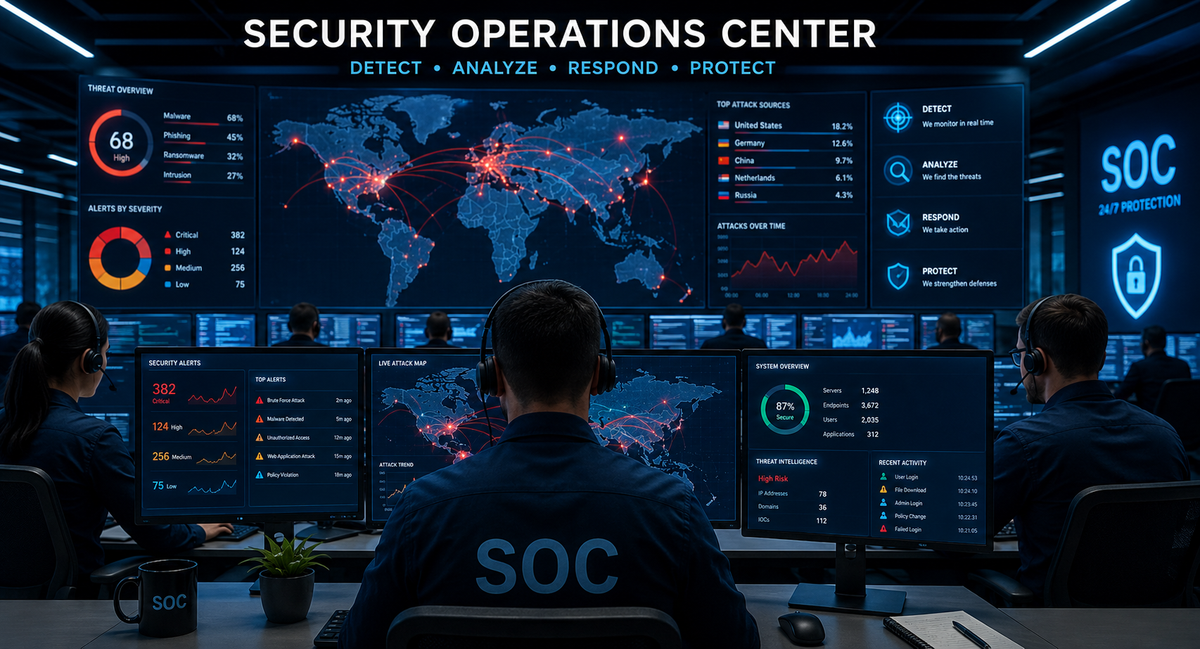
A Security Operations Center (SOC) is the operational core of an organization’s cybersecurity program—responsible for continuous monitoring, detection, analysis, and response to security incidents across infrastructure, applications, and users. For organizations running production workloads (web apps, email, LMS, ERP, cloud services), a SOC is what turns scattered logs into actionable defense.
1) Why a SOC Matters
Modern attack surfaces span on-prem servers, cloud workloads, endpoints, APIs, and identities. A SOC provides:
- 24/7 visibility across all assets
- Rapid detection of threats (malware, credential abuse, data exfiltration)
- Coordinated incident response to minimize blast radius
- Compliance support (audit trails, reporting, controls)
- Continuous improvement via threat intel and post-incident reviews
Without a SOC, logs exist—but no one is correlating, triaging, or responding in time.
2) Core SOC Functions (Operational Pipeline)
a) Data Collection & Normalization
- Sources: web servers (Apache/Nginx), mail (Exim), DBs, OS logs, firewalls, WAF, cloud audit logs
- Normalization into a common schema (e.g., ECS-like models)
b) Detection Engineering
- Rules/signatures (e.g., brute force, impossible travel, privilege escalation)
- Behavioral analytics (anomalies vs. baselines)
c) Alert Triage
- Severity classification (P1–P4)
- False-positive reduction using context (asset criticality, user role)
d) Investigation
- Timeline reconstruction (who, what, when, where)
- IOC matching (IPs, hashes, domains)
- Lateral movement analysis
e) Response & Containment
- Isolate hosts, disable accounts, block IPs/domains, revoke tokens
- Patch or reconfigure vulnerable services
f) Post-Incident Review
- Root cause analysis (RCA)
- Detection tuning and playbook updates
3) SOC Architecture (Reference Stack)


A pragmatic SOC stack typically includes:
1. Log Ingestion Layer
- Beats/agents, syslog, API collectors
- Message queues (Kafka/Redis) for buffering
2. SIEM (Security Information and Event Management)
- Central log store + correlation engine
- Examples: Elastic SIEM, Splunk, Wazuh
3. EDR/XDR
- Endpoint telemetry (processes, registry, network connections)
- Real-time containment (kill process, isolate host)
4. SOAR
- Playbook automation (e.g., auto-block IP, enrich alerts, open tickets)
- Reduces MTTR via orchestration
5. Threat Intelligence
- Feeds for known bad IPs/domains/hashes
- Enrichment (GeoIP, ASN, reputation scoring)
6. Case Management
- Ticketing (e.g., Jira, ServiceNow, or integrated tools)
- Evidence tracking and audit trails
4) SOC Team Structure (Roles & Responsibilities)
- Tier 1 Analyst (Monitoring & Triage)
First line—validates alerts, filters noise, escalates real incidents. - Tier 2 Analyst (Investigation)
Deep-dive analysis, correlation, scoping affected assets. - Tier 3 / Incident Responder
Advanced forensics, containment strategy, eradication. - Threat Hunter
Proactively searches for stealthy adversaries not caught by rules. - Detection Engineer
Builds and tunes detection logic (queries, rules, ML features). - SOC Manager
Oversees SLAs, staffing, reporting, and continuous improvement.
5) SOC Operating Models
- In-house SOC – Full control, higher cost, requires skilled staff
- Virtual SOC (vSOC) – Distributed team with centralized tooling
- MSSP (Managed Security Service Provider) – Outsourced monitoring/response
- Hybrid – Internal ownership + external monitoring support (common for SMEs)
6) Key Metrics (How You Measure a SOC)
- MTTD (Mean Time To Detect) – how fast threats are identified
- MTTR (Mean Time To Respond/Recover) – how fast incidents are contained
- Alert Volume vs. True Positives – signal-to-noise ratio
- Dwell Time – how long attackers remain undetected
- Coverage – % of assets/log sources monitored
7) Practical SOC Use Cases
- Brute-force attack on login endpoints → detect abnormal auth failures, auto-block IP
- Web exploitation (e.g., WordPress attacks) → WAF + SIEM correlation
- Email compromise → detect suspicious logins, reset credentials, revoke sessions
- Data exfiltration → detect unusual outbound traffic patterns
- Privilege escalation → alert on sudo/admin role anomalies
8) Building a SOC on a VPS (Lean Deployment)
Given a typical stack (Apache, MySQL/PostgreSQL, Docker, cloud workloads), a cost-efficient SOC can be implemented as follows:
Minimum Viable Stack
- Wazuh (SIEM + HIDS)
- Elastic Stack (log indexing + dashboards)
- Suricata (network IDS)
- OSQuery (endpoint visibility)
- TheHive + Cortex (case management & response)
Deployment Outline
- Centralize logs from all services (web, mail, DB, containers)
- Install agents on all servers/endpoints
- Define detection rules (SSH brute force, sudo abuse, web attacks)
- Integrate alerts with a ticketing system
- Automate response (fail2ban, firewall rules, API blocks)
- Create dashboards for real-time visibility
9) SOC Best Practices
- Log everything critical (auth, network, application, admin actions)
- Reduce noise early (baseline normal behavior)
- Automate repetitive tasks (SOAR playbooks)
- Continuously tune detections (false positives kill efficiency)
- Run tabletop exercises (simulate incidents)
- Adopt Zero Trust principles (never assume trust, always verify)
10) Common Pitfalls
- Over-collecting logs without useful correlation rules
- Ignoring alert fatigue → missed real incidents
- No clear incident response playbooks
- Lack of asset inventory (you can’t protect what you don’t know)
- Treating SOC as a tool, not a process + people + technology system
====
A Security Operations Center (SOC) is not just a room full of screens—it’s a disciplined operational capability that transforms raw telemetry into defensible action. Whether you run a small VPS environment or a multi-service platform, implementing even a lean SOC model dramatically improves your ability to detect, respond, and recover from cyber threats.
If you’re running production services (hosting, LMS, SaaS, email), a SOC is no longer optional—it’s foundational.