IATA Airport Codes Explained: Meaning, Purpose, and Key Airports by Continent and Country

IATA Airport Codes Explained: Meaning, Purpose, and Key Airports by Continent and Country
Introduction
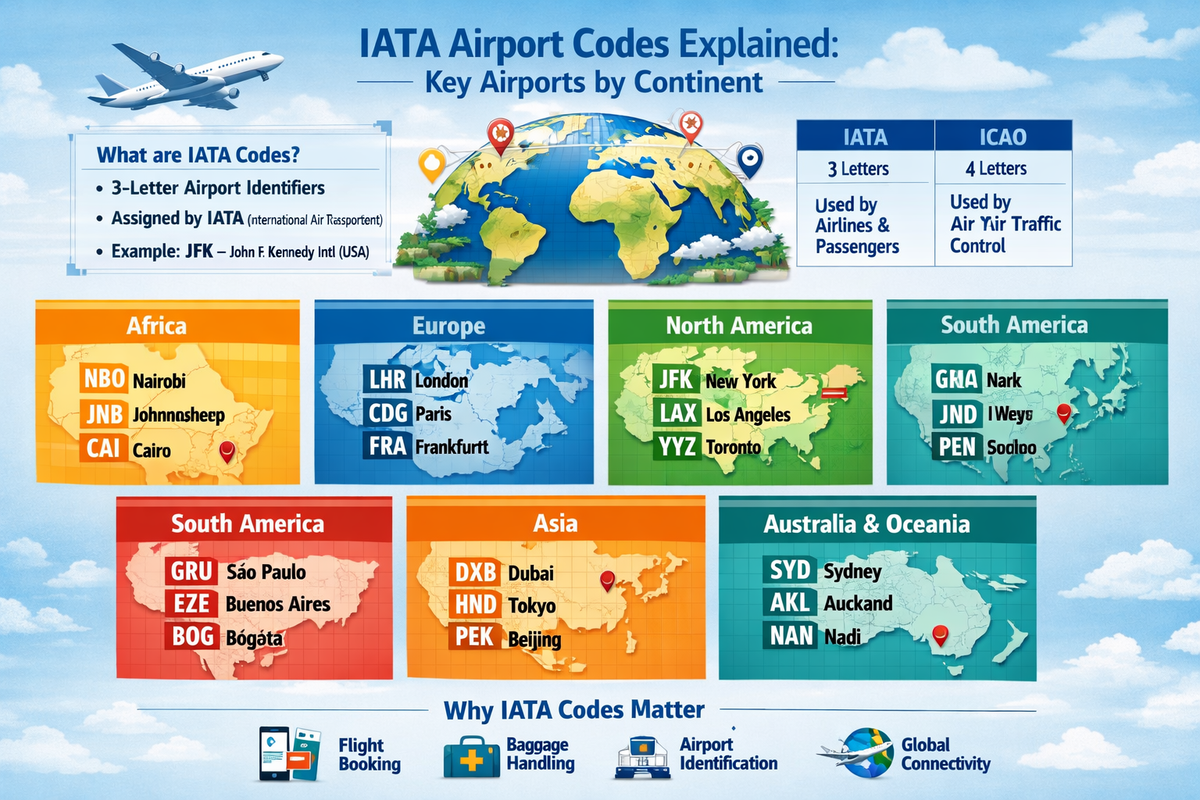
If you have ever booked a flight, tracked luggage, or read an airline ticket, you have encountered IATA airport codes—the three-letter identifiers used globally to represent airports. Codes such as NBO, LHR, JFK, or DXB are more than abbreviations; they are the backbone of modern air transport operations.
This article provides a detailed explanation of IATA codes, their importance, how they are assigned, and a continent-by-continent breakdown of major airports and their IATA codes, including key countries within each region.
What Are IATA Airport Codes?
IATA codes are three-letter airport identifiers assigned by the International Air Transport Association (IATA). They are used by:
- Airlines
- Travel agencies
- Global Distribution Systems (GDS)
- Baggage handling systems
- Passengers and aviation professionals
Example:
- NBO – Jomo Kenyatta International Airport (Kenya)
- LHR – London Heathrow Airport (United Kingdom)
- JFK – John F. Kennedy International Airport (USA)
Each code uniquely identifies an airport worldwide.
Why IATA Codes Are Important
IATA codes enable:
- Accurate flight booking and ticketing
- Efficient baggage routing
- Clear identification of departure and arrival airports
- Standardized global aviation communication
Without IATA codes, international air travel would be chaotic and error-prone.
How IATA Codes Are Assigned
IATA codes are generally derived from:
- City names (e.g., NBO – Nairobi)
- Airport names (e.g., JFK – John F. Kennedy)
- Historical or linguistic origins (e.g., ORD – Chicago O’Hare)
Some cities with multiple airports have different codes:
- London: LHR (Heathrow), LGW (Gatwick), STN (Stansted)
- Paris: CDG (Charles de Gaulle), ORY (Orly)
IATA Codes vs ICAO Codes
| Feature | IATA | ICAO |
|---|---|---|
| Length | 3 letters | 4 letters |
| Used by | Airlines & passengers | Air traffic control |
| Example (Nairobi) | NBO | HKJK |
This article focuses exclusively on IATA codes.
Major IATA Airport Codes by Continent
Africa
Key Airports in Africa
| Country | City | Airport | IATA Code |
|---|---|---|---|
| Kenya | Nairobi | Jomo Kenyatta Intl | NBO |
| South Africa | Johannesburg | OR Tambo Intl | JNB |
| Egypt | Cairo | Cairo Intl | CAI |
| Ethiopia | Addis Ababa | Bole Intl | ADD |
| Nigeria | Lagos | Murtala Muhammed Intl | LOS |
| Morocco | Casablanca | Mohammed V Intl | CMN |
| Ghana | Accra | Kotoka Intl | ACC |
| Tanzania | Dar es Salaam | Julius Nyerere Intl | DAR |
Europe
Key Airports in Europe
| Country | City | Airport | IATA Code |
|---|---|---|---|
| United Kingdom | London | Heathrow | LHR |
| France | Paris | Charles de Gaulle | CDG |
| Germany | Frankfurt | Frankfurt Airport | FRA |
| Netherlands | Amsterdam | Schiphol | AMS |
| Spain | Madrid | Adolfo Suárez | MAD |
| Italy | Rome | Fiumicino | FCO |
| Turkey | Istanbul | Istanbul Airport | IST |
| Switzerland | Zurich | Zurich Airport | ZRH |
North America
Key Airports in North America
| Country | City | Airport | IATA Code |
|---|---|---|---|
| United States | New York | John F. Kennedy Intl | JFK |
| United States | Los Angeles | LAX Intl | LAX |
| United States | Atlanta | Hartsfield–Jackson | ATL |
| Canada | Toronto | Pearson Intl | YYZ |
| Canada | Vancouver | Vancouver Intl | YVR |
| Mexico | Mexico City | Benito Juárez Intl | MEX |
South America
Key Airports in South America
| Country | City | Airport | IATA Code |
|---|---|---|---|
| Brazil | São Paulo | Guarulhos Intl | GRU |
| Argentina | Buenos Aires | Ezeiza Intl | EZE |
| Colombia | Bogotá | El Dorado Intl | BOG |
| Chile | Santiago | Arturo Merino Benítez | SCL |
| Peru | Lima | Jorge Chávez Intl | LIM |
Asia
Key Airports in Asia
| Country | City | Airport | IATA Code |
|---|---|---|---|
| United Arab Emirates | Dubai | Dubai Intl | DXB |
| China | Beijing | Capital Intl | PEK |
| Japan | Tokyo | Haneda | HND |
| Singapore | Singapore | Changi | SIN |
| India | Delhi | Indira Gandhi Intl | DEL |
| South Korea | Seoul | Incheon Intl | ICN |
| Thailand | Bangkok | Suvarnabhumi | BKK |
| Malaysia | Kuala Lumpur | KL Intl | KUL |
Australia & Oceania
Key Airports in Australia & Oceania
| Country | City | Airport | IATA Code |
|---|---|---|---|
| Australia | Sydney | Kingsford Smith | SYD |
| Australia | Melbourne | Melbourne Airport | MEL |
| New Zealand | Auckland | Auckland Intl | AKL |
| Fiji | Nadi | Nadi Intl | NAN |
| Papua New Guinea | Port Moresby | Jacksons Intl | POM |
Common Misconceptions About IATA Codes
- Codes are not random – most reflect city or airport names.
- Not all city codes match spelling (e.g., ORD for Chicago).
- One city can have multiple IATA codes.
- IATA ≠ ICAO – they serve different aviation functions.
Who Uses IATA Codes?
- Airlines and airline alliances
- Airport authorities
- Travel agents and booking platforms
- Logistics and cargo companies
- Immigration and border control systems
- Passengers worldwide
IATA airport codes are a critical global aviation standard, enabling safe, efficient, and reliable air travel. Understanding these codes is essential for travelers, aviation students, logistics professionals, and digital platforms dealing with flights and bookings.
From Nairobi (NBO) to Dubai (DXB) and New York (JFK), IATA codes form a universal aviation language connecting every continent and country.