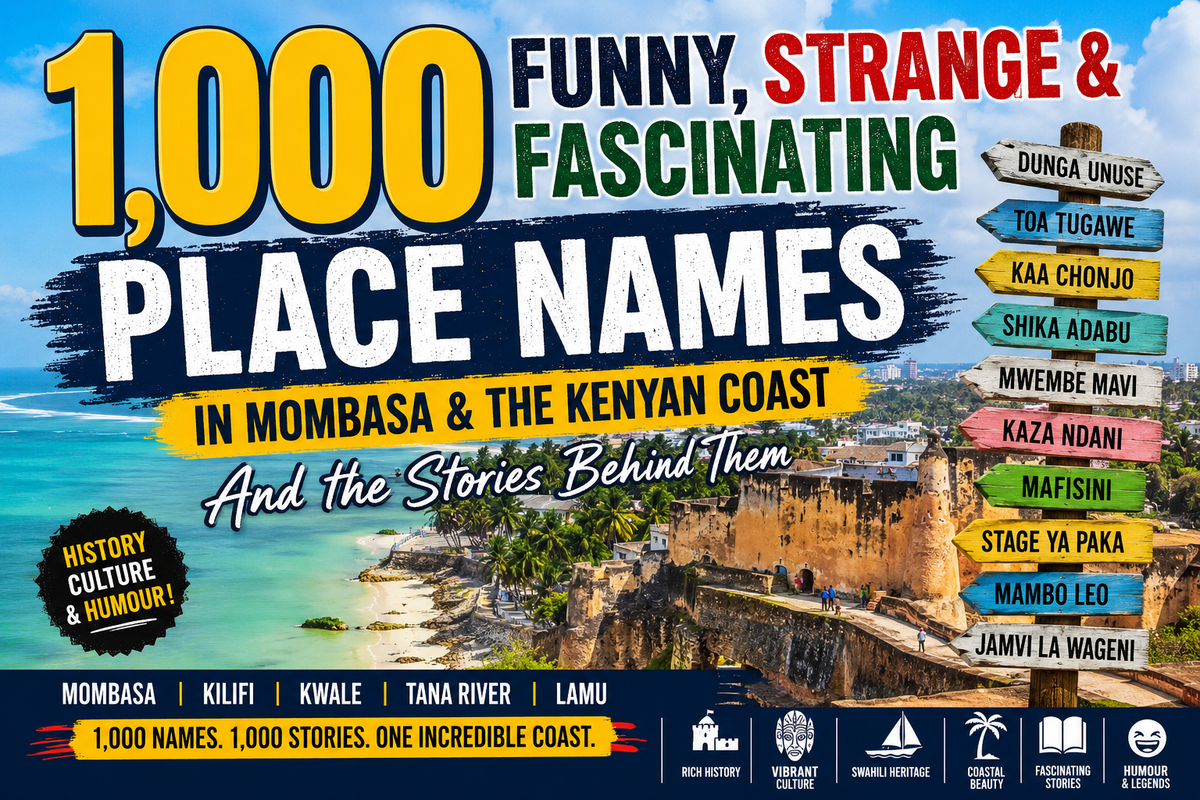
1,000 Funny, Strange & Fascinating Place Names in Mombasa & the Kenyan Coast

You Can Laugh at the Name, But Don't Laugh at the History
If you have ever travelled around Mombasa, Kilifi, Kwale, Tana River or Lamu, you may have encountered a place whose name made you stop and ask:
"Wait... that is actually the name of the place?"
Welcome to the Kenyan Coast.
From Dunga Unuse and Toa Tugawe to Shika Adabu, Kaa Chonjo, Mwembe Mavi, Mafisini, Kaza Ndani and Dongo Kundu, the Coast has an extraordinary collection of names that can sound hilarious to outsiders.
But there is a catch.
Many of these names are not jokes at all.
They are pieces of history.
They preserve memories of old settlements, chiefs, rivers, battles, trade routes, farms, wells, wildlife, occupations, physical features and everyday conversations that happened generations ago.
Mombasa itself has a history stretching back many centuries. Its strategic position on the Indian Ocean made it an important centre of commerce connecting East Africa with Arabia, Persia, India and other parts of the Indian Ocean world.
So, behind almost every strange-sounding name is a story.
1. Dunga Unuse
Location: Mombasa County
Dunga Unuse is one of those names that immediately makes visitors wonder whether somebody was having a particularly creative afternoon when the neighbourhood was named.
It is regularly mentioned among Mombasa's famously unusual place names.
The name has become part of Mombasa's local folklore, with different explanations circulating about its origin. That is important because not every popular explanation of a place name can be treated as established historical fact.
And that is one of the fascinating things about Coast history.
Sometimes there is an official explanation.
Sometimes there is an oral tradition.
And sometimes there are three uncles at the same roadside shop who all have completely different versions.
2. Toa Tugawe
Location: Mombasa
If you are unfamiliar with Kiswahili, Toa Tugawe sounds almost like somebody giving instructions during a family argument.
It is, however, a recognised Mombasa locality.
The name is frequently listed alongside Dunga Unuse, Mwembe Mavi and Kaza Ndani among Mombasa's curious neighbourhood names. Local reporting has documented the names and the amusement they cause among visitors.
The important lesson?
Never judge a Coast place name from its English translation.
There is usually a story hiding underneath it.
3. Mwembe Mavi
Location: Mombasa
This is another name guaranteed to make a first-time visitor ask:
"Seriously?"
Yes.
Mwembe Mavi exists.
The name is particularly amusing to people unfamiliar with the history and vocabulary of coastal settlements. Interestingly, local reporting has pointed out that the neighbourhood itself may be considerably cleaner than its rather unfortunate-sounding name suggests.
This is a perfect example of why place names should not be judged by modern ears.
A name can survive for generations long after the circumstances that produced it have disappeared.
4. Kaza Ndani
Location: Mombasa
Another classic.
Kaza Ndani sounds like advice somebody might give before a difficult examination.
But it is a real Mombasa neighbourhood.
Local reporting has included Kaza Ndani among the city's memorable place names, alongside Toa Tugawe, Dunga Unuse and Mwembe Mavi.
For visitors, the name is funny.
For residents, it is home.
That distinction is worth remembering throughout this entire list.
5. Kaa Chonjo
Location: Mombasa
This one sounds less like a place name and more like a public-service announcement:
"Kaa chonjo!"
In Kiswahili, the phrase carries the idea of staying alert or being watchful.
Kaa Chonjo is a recognised locality in Mombasa and is also associated with a bus stop and a school.
The name has even become part of modern local humour because it sounds exactly like something somebody would tell you before sending you into a complicated Mombasa neighbourhood.
6. Shika Adabu
Location: Likoni, Mombasa
Another brilliant example.
Shika Adabu can be understood in the sense of being respectful or behaving properly.
And yes, it is a real place.
The official Mombasa County village administration documentation lists Shika Adabu among the local administrative areas of Likoni.
You could almost imagine an old village elder saying:
"Before you enter this place, shika adabu."
Whether that was actually the origin is another question. Oral histories need to be separated from documented etymology.
7. Dongo Kundu
Location: Mombasa County
Dongo Kundu is another famous Coast name.
The name is particularly memorable because of its unusual sound to non-Swahili speakers.
Unlike some of the names on this list, Dongo Kundu is also a major geographical reference in modern Mombasa, particularly in connection with the southern mainland and infrastructure development.
It demonstrates something important about coastal place names:
A name can move from being an obscure local reference to becoming a major geographical landmark.
8. Mafisini
Location: Mombasa
Another name that sounds almost comically dramatic to somebody hearing it for the first time.
Mafisini.
The name is regularly included in discussions of Mombasa's unusual localities.
The deeper story is that coastal place names frequently reflect descriptions, nicknames and everyday language rather than the formal naming conventions visitors might expect.
9. Stage ya Paka
Location: Mombasa
Now this sounds like somewhere you would expect to find an extremely important cat waiting for a matatu.
Stage ya Paka.
The name has been mentioned in accounts of Mombasa's unusual place names.
It is a wonderful reminder of how transport culture, landmarks and informal directions can eventually become permanent geographical references.
10. Kwa Punda
Location: Mombasa
Another name that makes outsiders smile.
Kwa Punda.
The donkey has historically been an important part of coastal transport culture, particularly in areas where narrow streets, sandy terrain and traditional trading routes made animal transport practical.
That makes names involving animals especially interesting.
They can preserve memories of how people once moved around long after motor vehicles transformed the Coast.
11. Ganjoni
Location: Mombasa
Ganjoni may not sound as funny as Dunga Unuse, but its history is fascinating.
One historical account describes the area around Mazeras as having been known as Ganjoni, associated with ruins and repeated attacks during earlier caravan periods.
Today, Ganjoni is a well-known Mombasa neighbourhood.
The contrast between the modern residential area and its older historical associations shows how dramatically coastal settlements have changed.
12. Mazeras
Location: Kilifi County / Mombasa hinterland
Mazeras is one of the Coast's better-known examples of a place named after a person.
Historical accounts associate the name with Chief Mazera, a Duruma leader who lived in the area. Traders travelling through the region began associating the locality with his name.
So when someone says "Mazeras," they may unknowingly be repeating the name of a historical local leader.
13. Mariakani
Location: Kilifi County
Mariakani has one of the most interesting explanations in coastal place-name history.
The name is associated with the Duruma term Mathyakani, connected with the idea of a place of quivers.
Historical accounts connect the name with travellers and warriors who passed through the area. One tradition holds that weapons were left there before travellers proceeded towards Mombasa because of restrictions on carrying weapons into the city.
Imagine that.
A modern town whose name may preserve a memory of where people once left their quivers.
That is not just geography.
That is history hiding inside vocabulary.
14. Maji ya Chumvi
Location: Coast region
The name literally evokes salt water.
Historical accounts say the locality was previously known as Gulugulu, a name associated with a local stream among the Mijikenda, before the name Maji ya Chumvi became established during the period of the Swahili slave-caravan era.
This is a particularly useful example of how place names can change as political, economic and cultural systems change.
15. Samburu
Location: Coast hinterland
The Coast has a Samburu too.
And no, that does not mean somebody accidentally transported northern Kenya to the Coast.
A historical account says the locality was formerly known as Kirauho among the Mijikenda and that the name Samburu became associated with the area during the slave-caravan period, reportedly referring to the last significant water source before Voi.
The name therefore connects geography with the practical realities of long-distance travel.
Water mattered.
A lot.
16. Mombasa
The mother of the list
You cannot write about strange or fascinating Coast place names without beginning with Mombasa itself.
The city's history is ancient and layered.
Historical traditions connect the city with figures such as Mwana Mkisi and Shehe Mvita, while historical scholarship records Mombasa as an important Swahili urban centre shaped by African communities and Indian Ocean connections.
Mombasa has also been known as Mvita, a Swahili name associated with war, reflecting the city's long history of conflict and competition. Historical accounts describe Portuguese attacks, Omani intervention and struggles over control of the strategic port.
So the city with the funny-sounding names has a very serious history.
17. Kongowea
Location: Mombasa / Nyali area
Kongowea is particularly important because it appears in traditions concerning the early history of Mombasa.
According to historical traditions, Mwana Mkisi is associated with the founding of Kongowea, regarded in those traditions as an early settlement connected with Mombasa.
Today the name is familiar to thousands of people because of Kongowea Market.
That means a modern shopping destination carries a name connected to very old traditions about Mombasa's beginnings.
18. Likoni
Location: South Mombasa
Likoni is one of Mombasa's best-known southern areas.
It is now strongly associated with the Likoni Ferry, residential neighbourhoods and the southern mainland.
But the wider area contains numerous smaller names whose origins reveal layers of Swahili and Mijikenda history.
The official county village records, for example, contain names such as Shika Adabu, Barabara Mchanga, Vijiweni, Bankani, Kwa Joho, Muembe Dodo, Kibundani, Kataa, Brazil, Inuka, Pungu Villa, Mambo Leo and Jamvi la Wageni.
And this is where the list gets seriously interesting.
19. Barabara Mchanga
Location: Likoni
Literally, the name evokes a sandy road.
Anyone familiar with coastal roads can understand why such a description could become a place name.
Sand is not just scenery at the Coast.
It has historically shaped transport, settlement and daily life.
20. Mambo Leo
Location: Likoni
Mambo Leo translates roughly to "things today" or "today's affairs."
It sounds like a newspaper headline.
But it is also listed among the official village units in Likoni.
Imagine explaining your address:
"Where do you live?"
"Mambo Leo."
"What happened?"
"No, that's where I live."
21. Brazil
Location: Likoni
Yes.
Brazil.
There is a locality carrying the name in Mombasa's Likoni administrative records.
It is an excellent reminder that place names can travel surprisingly far from their apparent geographical origins.
The name does not mean the Kenyan Coast suddenly moved to South America.
It is simply one of the many modern locality names that have entered the coastal urban landscape.
22. Pentagon
Location: Likoni
And then there is:
Pentagon.
Listed among Likoni's localities, it is another example of modern naming sitting alongside centuries-old Swahili and Mijikenda names.
Coastal geography is basically a historical layer cake.
23. Jamvi la Wageni
Location: Likoni
Now this one is wonderfully Swahili.
Jamvi la Wageni can be understood as something along the lines of a mat/platform for guests.
The name appears in Mombasa County's official village administration records.
It sounds like the sort of place where someone would tell you:
"Karibu, kaa hapa."
Why Does the Kenyan Coast Have So Many Unusual Names?
The answer is history.
The Coast has been a meeting point of cultures for centuries.
The Swahili civilisation developed through long interaction among African coastal communities and Indian Ocean trading networks. The region's history includes African, Arab, Persian, Indian and European influences.
Consequently, Coast place names can originate from:
- Kiswahili
- Mijikenda languages
- Arabic
- Portuguese
- English
- names of chiefs
- names of rivers and streams
- physical features
- old occupations
- trade routes
- traditional stories
- battles and conflicts
- wells and water sources
- animals
- farming
- transport
- colonial administration
- nicknames
- oral traditions
And sometimes...
Someone simply said something funny, everybody remembered it, and 80 years later it was on the map.
The Coast's Place-Name Rule
There is one golden rule when investigating these names:
Don't confuse a popular story with proven history.
Some Coast place-name explanations are based on oral tradition.
Others appear in historical documents.
Some have multiple competing explanations.
And some have origins that researchers have not conclusively established.
That makes the subject even more interesting.
A good historical article should therefore label explanations appropriately:
Documented: supported by reliable historical records.
Traditional: preserved through oral history.
Reported: published by a source but requiring further verification.
Uncertain: multiple explanations exist.
That approach keeps the humour while respecting the people and communities behind the names.
The Beginning of the Ultimate Top 1,000
The names above are only the opening chapter.
A genuinely comprehensive Top 1,000 Mombasa & Coast Place Names should cover the entire coastal region, including:
Mombasa County
Mombasa Island, Likoni, Changamwe, Kisauni, Nyali, Jomvu and their neighbourhoods, villages, estates, roads, landmarks and historical localities.
Kilifi County
Kilifi, Malindi, Watamu, Mtwapa, Mariakani, Mazeras and surrounding settlements.
Kwale County
Ukunda, Diani, Kinango, Msambweni, Lunga Lunga, Shimoni and surrounding villages.
Tana River County
Garsen, Hola, Kipini and settlements along the Tana River.
Lamu County
Lamu, Shela, Mokowe, Hindi, Mpeketoni, Pate, Siyu, Faza and the historic island settlements.
Why This List Matters
At first glance, a list of funny place names looks like internet entertainment.
But it is actually a history project.
A place name can preserve a memory after buildings disappear.
It can remember a chief after generations have passed.
It can preserve the name of a river that has changed course.
It can tell us where traders travelled.
It can reveal what people feared.
It can tell us what they valued.
It can even preserve a joke.
That makes the Kenyan Coast one giant open-air historical dictionary.
And somewhere between Kaa Chonjo, Shika Adabu, Mambo Leo, Dunga Unuse, Toa Tugawe, Mwembe Mavi, Mazeras, Mariakani and Mombasa, you eventually realise something:
The Coast didn't just name its places.
It left stories behind.
Coming in the full 1,000-name edition
The complete database can be organised as:
| Rank | Place | County | Area | Name meaning/origin | Historical story | Confidence |
|---|---|---|---|---|---|---|
| 1 | Dunga Unuse | Mombasa | Mombasa | To be researched | Oral/local history | Traditional |
| 2 | Toa Tugawe | Mombasa | Mombasa | To be researched | Local naming tradition | Traditional |
| 3 | Mwembe Mavi | Mombasa | Mombasa | Swahili-derived name | Local history | Reported |
| 4 | Kaza Ndani | Mombasa | Mombasa | Swahili phrase | Local history | Reported |
| 5 | Kaa Chonjo | Mombasa | Tudor area | "Stay alert" | Local locality | Documented locality |
| 6 | Shika Adabu | Mombasa | Likoni | "Observe manners/respect" | Local history | Documented locality |
| 7 | Dongo Kundu | Mombasa | South Coast | Local coastal name | Historical locality | Documented |
| 8 | Ganjoni | Mombasa | Mombasa | Historical locality name | Caravan-era history | Reported |
| 9 | Mazeras | Kilifi | Mazeras | Associated with Chief Mazera | Duruma history | Historical tradition |
| 10 | Mariakani | Kilifi | Mariakani | Associated with "place of quivers" | Caravan/battle tradition | Historical tradition |
| 11 | Maji ya Chumvi | Coast | Coast | "Salt water" | Earlier name reportedly Gulugulu | Reported |
| 12 | Samburu | Coast | Coast | Historical route/water reference | Caravan history | Reported |
| 13 | Mambo Leo | Mombasa | Likoni | "Things today" | Modern locality | Documented locality |
| 14 | Brazil | Mombasa | Likoni | Modern locality name | Local naming | Documented locality |
| 15 | Pentagon | Mombasa | Likoni | Modern locality name | Local naming | Documented locality |
| 16 | Jamvi la Wageni | Mombasa | Likoni | "Mat/place for guests" | Local naming | Documented locality |
| 17 | Kongowea | Mombasa | Nyali | Ancient settlement tradition | Mombasa origin traditions | Historical tradition |
| 18 | Mombasa | Mombasa | Island | Ancient Swahili city | Indian Ocean history | Well documented |