Why Domains for Decentralized Applications Get Suspended Shortly After Deployment

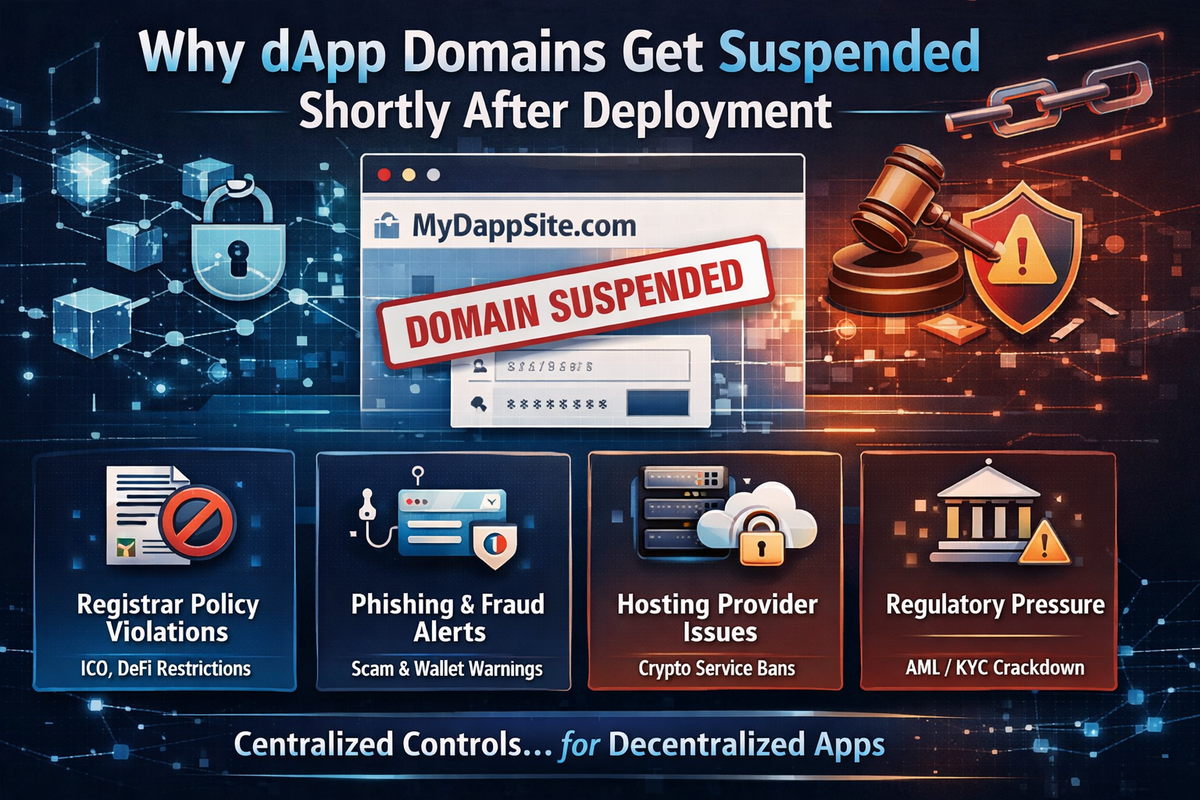
Why Domains for Decentralized Applications Get Suspended Shortly After Deployment
Decentralized applications (dApps) promise an internet that is trustless, censorship-resistant, and not controlled by a single authority. Built on distributed blockchain networks, these applications operate through smart contracts and peer-to-peer infrastructure rather than centralized servers.
However, a paradox exists: many dApps rely on centralized web infrastructure, especially domain names and DNS services. As a result, developers frequently encounter a frustrating situation where their domain is suspended within weeks—or even days—after launch.
This article provides a comprehensive analysis of why dApp domains are often suspended shortly after purchase or deployment, examining technical, regulatory, operational, and policy-driven factors.
1. The Centralization Paradox of Decentralized Applications
While the backend logic of a dApp may run on blockchain networks like:
- Ethereum
- Solana
- Polygon
the user-facing layer typically depends on traditional web infrastructure, including:
- Domain registrars
- DNS providers
- Web hosting platforms
- CDN services
These components operate under centralized governance frameworks controlled by organizations such as:
- Internet Corporation for Assigned Names and Numbers
Because of this dependency, a registrar or DNS provider can suspend the domain even if the application itself remains functional on blockchain.
2. Registrar Policy Restrictions on Cryptocurrency and DeFi
Most domain registrars maintain strict acceptable-use policies that regulate how domains can be used.
Commonly restricted activities include:
- Token sales and ICO promotions
- Cryptocurrency exchanges without licenses
- Decentralized finance (DeFi) lending services
- Crypto gambling platforms
- Anonymous financial transactions
These restrictions are often influenced by regulatory frameworks and international financial monitoring bodies such as:
- Financial Action Task Force
Registrars may suspend domains when their automated systems detect content that appears to offer financial services without proper regulatory compliance.
For example, a website offering staking rewards or token swaps might be interpreted as an unlicensed financial platform.
3. Automated Phishing and Scam Detection Systems
Another major cause of domain suspension is automated abuse detection.
Crypto-related websites often resemble the design patterns used in phishing attacks targeting cryptocurrency wallets.
Common triggers include pages that request:
- wallet connection
- private key entry
- seed phrase recovery
- token claims
These patterns resemble phishing pages designed to steal credentials from wallets like:
- MetaMask
- Trust Wallet
Security monitoring platforms frequently report such domains to registrars or blacklist databases.
When this happens, the domain may be suspended pending investigation.
4. DNS Abuse Reporting and Security Blacklists
Security organizations constantly monitor the internet for malicious activity.
If a domain appears suspicious, it may be flagged by threat-intelligence services such as:
- Spamhaus Project
- Google Safe Browsing
Once a domain appears in these databases, browsers, registrars, and hosting providers may:
- block access
- suspend DNS resolution
- disable hosting services
In some cases, false positives occur, particularly with newly launched crypto platforms that resemble phishing sites.
5. Trademark and Intellectual Property Complaints
Another frequent cause of domain suspension is trademark infringement claims.
Crypto startups sometimes launch projects with names similar to well-known blockchain platforms or tokens. If a complaint is filed, registrars typically follow dispute-resolution procedures such as:
- Uniform Domain-Name Dispute-Resolution Policy
During the investigation, the domain may be locked or suspended.
This often happens when:
- a token name resembles a known brand
- logos from established platforms are reused
- domains mimic existing exchanges or wallets
6. Hosting Provider Restrictions on Blockchain Activity
Even if the domain registrar allows the domain to remain active, hosting providers may impose their own restrictions.
Cloud platforms frequently restrict or monitor activities such as:
- crypto mining
- token minting platforms
- decentralized exchanges
- NFT marketplaces
Infrastructure providers like:
- Amazon Web Services
- Google Cloud
may suspend accounts that violate their acceptable-use policies.
Automated abuse-detection algorithms may interpret high blockchain-related traffic as suspicious activity.
7. Payment Risk and Fraud Prevention
Domain purchases made with anonymous payment methods are often flagged for manual review.
High-risk payment indicators include:
- cryptocurrency payments
- prepaid debit cards
- newly created payment accounts
- mismatched geographic data
If the registrar detects suspicious payment patterns combined with high-risk website content, the domain may be temporarily suspended.
8. Increasing Regulatory Pressure on Web3 Platforms
Governments worldwide are increasing oversight of blockchain platforms.
Financial regulators are especially concerned about:
- money laundering
- fraud
- unregistered securities offerings
Agencies such as:
- U.S. Securities and Exchange Commission
have taken enforcement actions against various crypto services.
Although these actions target companies, registrars sometimes suspend domains proactively to reduce legal risk.
9. New ICANN DNS Abuse Enforcement Policies
Recent policy changes introduced stricter DNS abuse mitigation requirements.
Registrars are now required to take action against domains involved in:
- phishing
- malware
- botnets
- fraud schemes
These policies were promoted by:
- Internet Corporation for Assigned Names and Numbers
As a result, registrars increasingly suspend suspicious domains quickly, sometimes before a full investigation is completed.
10. How Web3 Projects Reduce the Risk of Domain Suspension
To avoid reliance on centralized DNS infrastructure, many blockchain projects adopt decentralized naming systems.
Popular options include:
- Ethereum Name Service
- Unstoppable Domains
These systems allow developers to use blockchain-based domain names such as:
projectname.eth
wallet.crypto
marketplace.x
These names are stored on blockchain networks rather than traditional DNS registries, making them more resistant to censorship or suspension.
11. Alternative Decentralized Hosting Architectures
To further reduce centralization risks, many dApps deploy front-end interfaces using distributed storage networks.
Examples include:
- IPFS
- Arweave
A typical resilient dApp architecture may look like this:
Frontend Interface → IPFS
Smart Contracts → Ethereum
File Storage → Arweave
Wallet Authentication → MetaMask
Naming System → ENS
In such a setup, even if a traditional domain is suspended, users can still access the application through decentralized gateways.
12. Best Practices for Developers Deploying dApps
To minimize domain suspension risk, developers should follow several practical guidelines.
1. Avoid phishing-like UI patterns
Do not request private keys or seed phrases.
2. Provide transparent project information
Include:
- company identity
- contact details
- legal disclaimers
3. Comply with financial regulations
If the application handles financial transactions, regulatory compliance may be required.
4. Use reputable hosting providers
Avoid anonymous hosting setups that trigger abuse detection.
5. Consider hybrid architectures
Combine traditional domains with decentralized alternatives such as ENS.
Conclusion
Decentralized applications represent a transformative approach to building digital services. Yet despite their decentralized architecture, they often rely on centralized components such as domain registrars, DNS providers, and cloud infrastructure.
This dependency creates a vulnerability: domains for dApps may be suspended quickly due to regulatory pressure, automated abuse detection, trademark disputes, or hosting restrictions.
As the Web3 ecosystem matures, developers increasingly adopt decentralized naming systems and distributed hosting platforms to reduce reliance on centralized gatekeepers.
Understanding these challenges—and designing infrastructure accordingly—is essential for ensuring that decentralized applications remain accessible, resilient, and resistant to shutdowns.