The Advantages of Having a Work Schedule as a Professional or Employee

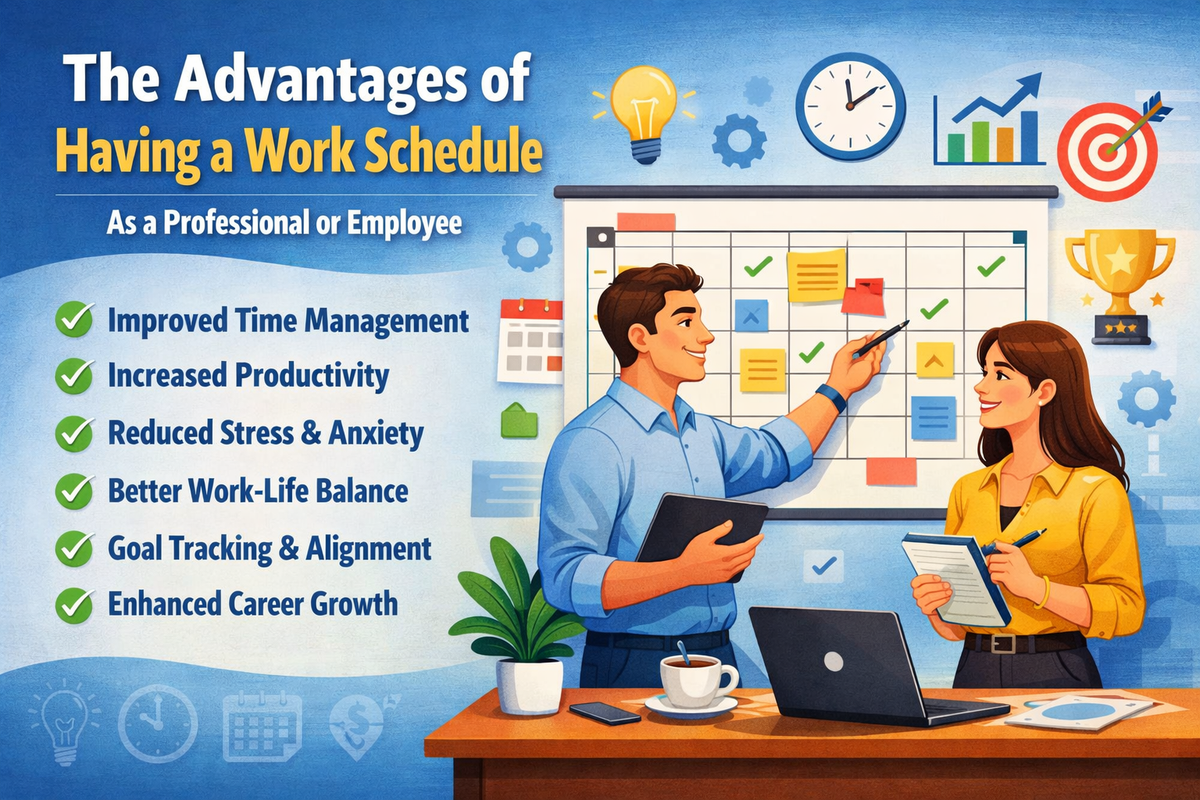
In today’s fast-paced and highly competitive work environment, productivity is no longer just about working harder—it’s about working smarter. One of the most effective tools for achieving this is a well-structured work schedule. Whether you are a corporate employee, entrepreneur, freelancer, or skilled professional, having a daily work schedule is a foundational practice that directly impacts performance, consistency, and overall career growth.
This article provides a detailed analysis of the advantages of maintaining a work schedule and why it should be a non-negotiable part of your professional routine.
1. Improved Time Management
A work schedule enforces intentional allocation of time to tasks. Instead of reacting to work as it comes, you proactively define what gets done and when.
Key impact:
- Reduces time wastage and idle periods
- Helps prioritize high-value tasks
- Prevents overcommitment
Professionals who operate without a schedule often underestimate how much time tasks consume, leading to missed deadlines. A schedule introduces structure and predictability.
2. Increased Productivity and Efficiency
A defined schedule minimizes decision fatigue—the mental drain caused by constantly deciding what to do next.
How it helps:
- Tasks are pre-planned, so execution becomes faster
- Eliminates unnecessary multitasking
- Enables deep work sessions
When your day is mapped out, you transition from “thinking about work” to actually “doing the work,” which significantly boosts output.
3. Better Task Prioritization
Not all tasks carry equal importance. A schedule allows you to categorize tasks based on urgency and impact.
Common prioritization frameworks:
- Urgent vs Important (Eisenhower Matrix)
- High-value vs low-value tasks
- Short-term vs long-term goals
This ensures critical deliverables are handled first, reducing last-minute pressure.
4. Reduced Stress and Anxiety
Unstructured work often leads to uncertainty—missed deadlines, forgotten tasks, and last-minute rushes.
A schedule:
- Provides clarity on what needs to be done
- Reduces mental clutter
- Creates a sense of control over your workload
Knowing that everything has a designated time slot significantly lowers anxiety levels.
5. Consistency and Discipline
Consistency is what separates average performers from high achievers. A work schedule builds discipline by creating repeatable patterns.
Benefits:
- Develops strong work habits
- Encourages accountability
- Enhances reliability in professional environments
Over time, disciplined scheduling leads to sustained performance improvements.
6. Enhanced Work-Life Balance
Without a schedule, work can easily spill into personal time. A structured plan creates boundaries.
Advantages:
- Allocates time for both work and personal activities
- Prevents burnout
- Encourages proper rest and recovery
For employees, this ensures better job satisfaction. For professionals and entrepreneurs, it sustains long-term productivity.
7. Goal Alignment and Tracking
A schedule is not just about daily tasks—it is a tool for aligning daily actions with long-term objectives.
How it works:
- Breaks down large goals into manageable tasks
- Tracks progress over time
- Identifies performance gaps
This transforms abstract goals into actionable steps.
8. Improved Professional Reputation
Reliability is a key metric in any professional setting. A structured schedule ensures you:
- Meet deadlines consistently
- Deliver quality work on time
- Maintain professionalism
This enhances trust among colleagues, clients, and management.
9. Better Adaptability and Planning
Contrary to common belief, schedules do not limit flexibility—they improve it.
When your day is structured:
- You can easily adjust tasks when emergencies arise
- You understand what can be postponed or delegated
- You maintain control even during disruptions
A schedule acts as a baseline, making adjustments more strategic rather than reactive.
10. Enhanced Focus and Reduced Distractions
A clear schedule minimizes distractions by assigning specific time blocks for tasks.
Techniques that complement scheduling:
- Time blocking
- Pomodoro technique
- Task batching
These methods ensure maximum concentration during work sessions.
11. Accountability and Performance Measurement
A schedule acts as a performance benchmark.
You can evaluate:
- Tasks completed vs planned
- Time spent per task
- Productivity trends
This data-driven approach enables continuous improvement.
12. Supports Career Growth and Skill Development
With a schedule, you can deliberately allocate time for:
- Learning new skills
- Professional development
- Certifications and training
This ensures you remain competitive in your field.
Best Practices for Creating an Effective Work Schedule
To maximize the benefits, consider the following:
- Start with clear goals – Define what you want to achieve daily, weekly, and monthly
- Prioritize tasks – Focus on high-impact activities first
- Use digital tools – Tools like Google Calendar, Notion, or Trello can help automate scheduling
- Be realistic – Avoid overloading your schedule
- Include breaks – Maintain energy and focus
- Review daily – Adjust based on performance and workload
Conclusion
A work schedule is more than a productivity tool—it is a strategic framework for professional success. It enhances time management, reduces stress, improves efficiency, and aligns daily actions with long-term goals.
Whether you are an employee striving for career growth or a professional managing multiple responsibilities, adopting a structured work schedule is one of the simplest yet most powerful habits you can develop.
In a world where time is the most valuable resource, those who manage it effectively will always stay ahead.