Inside Kenya’s Naivasha–Malaba SGR: The Future of East African Trade

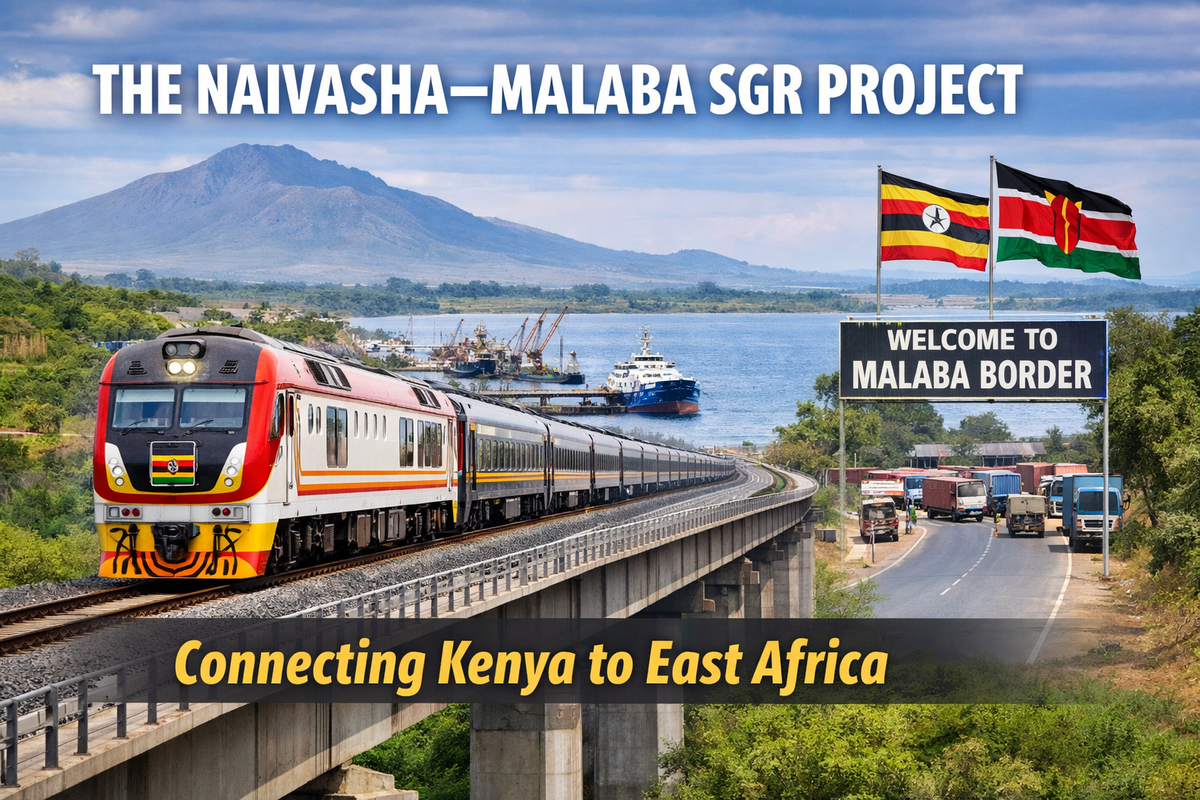
The Naivasha–Malaba SGR Project: Kenya’s Strategic Rail Corridor to East Africa
Executive Summary
The Naivasha–Malaba Standard Gauge Railway (SGR) is a transformative infrastructure project that represents the final Kenyan segment of a modern rail corridor linking the Indian Ocean port of Mombasa to the heart of East and Central Africa. Extending the existing SGR from Naivasha through Kisumu to Malaba at the Uganda border, this project is central to Kenya’s long-term economic blueprint and regional integration ambitions.
With an estimated cost exceeding KSh 600 billion, the project has faced delays due to financing constraints but is now being revived under a new hybrid funding model. Once completed, it is expected to significantly reduce logistics costs, enhance trade competitiveness, and position Kenya as a regional logistics hub.
1. Historical Context and Evolution of the SGR
Kenya’s SGR project is part of a broader vision to modernize transport infrastructure and replace the aging metre-gauge railway built during the colonial era.
Completed Phases
- Mombasa → Nairobi (Phase 1)
- Commissioned in 2017
- ~472 km
- Primarily freight and passenger transport
- Nairobi → Naivasha (Phase 2A)
- Completed in 2019
- ~120 km
- Includes the Naivasha Inland Container Depot (ICD)
Pending Phases (Focus of this Blog)
- Phase 2B: Naivasha → Kisumu
- Phase 2C: Kisumu → Malaba
These phases complete Kenya’s portion of the Northern Corridor railway.
2. Strategic Importance of the Naivasha–Malaba Extension
2.1 Regional Trade Backbone
The SGR is not just a national project—it is a regional logistics artery connecting:
- Kenya
- Uganda
- Rwanda
- South Sudan
- Democratic Republic of Congo (DRC)
Malaba serves as a key border gateway, making this extension critical for cross-border freight movement.
2.2 Integration with the Northern Corridor
The project strengthens the Northern Corridor, East Africa’s busiest trade route, linking:
- Port of Mombasa → Inland markets → Landlocked countries
By shifting cargo from road to rail, the SGR will:
- Reduce transit times
- Lower transportation costs
- Improve cargo reliability
2.3 Connection to Lake Victoria
The Kisumu segment introduces multimodal transport via Lake Victoria, enabling:
- Rail-to-water cargo transfer
- Direct trade links to Tanzania and Uganda via lake ports
- Revival of Kisumu as a major port city
3. Technical Specifications
3.1 Core Design Features
- Gauge: Standard gauge (1,435 mm)
- Train Type: Diesel-powered (with future electrification potential)
- Speed:
- Passenger: up to 120 km/h
- Freight: up to 80 km/h
3.2 Infrastructure Components
- Rail tracks and stations
- Bridges and tunnels
- Dry ports and logistics hubs
- Signaling and communication systems
3.3 Key Nodes
- Naivasha ICD (logistics hub)
- Kisumu Port
- Malaba border terminal
4. Route Analysis and County-Level Impact
The railway traverses several economically significant counties:
Rift Valley Region
- Narok: Agricultural and tourism zone
- Bomet & Kericho: Tea-growing regions
Western Kenya
- Nyamira & Kisumu: Trade and fishing hubs
- Busia (Malaba): Major border crossing
Economic Implications
- Faster movement of agricultural produce
- Reduced post-harvest losses
- Improved market access for rural producers
5. Financing Structure: From Chinese Loans to Hybrid Models
5.1 Initial Financing Challenges
Earlier SGR phases relied heavily on Chinese Exim Bank loans, raising concerns about:
- Debt sustainability
- High repayment obligations
- Fiscal pressure on Kenya’s economy
5.2 New Financing Approach
The Naivasha–Malaba extension adopts a diversified model:
a) Railway Development Levy (RDL)
- A 2% levy on imports
- Generates billions annually
- Used as collateral for infrastructure financing
b) Public–Private Partnerships (PPP)
- Private sector participation in:
- Rolling stock
- Operations
- Maintenance
c) Multilateral Funding
- Potential involvement from:
- African Development Bank (AfDB)
- World Bank (indirect support structures)
d) Infrastructure Bonds
- Domestic capital market financing
6. Implementation Framework
Key Stakeholders
- Kenya Railways Corporation (KRC) – Project owner/operator
- Ministry of Transport – Policy direction
- National Land Commission (NLC) – Land acquisition
Contractors
- China Road and Bridge Corporation (CRBC)
- Other international and local subcontractors
7. Economic Impact Assessment
7.1 GDP Contribution
The project is expected to:
- Boost Kenya’s GDP through infrastructure investment
- Stimulate industrialization along the corridor
7.2 Logistics Cost Reduction
Transporting goods via SGR is:
- Cheaper than road (bulk cargo)
- Faster and more predictable
7.3 Trade Expansion
- Increased exports (tea, horticulture, minerals)
- Improved import distribution inland
7.4 Urbanization and Industrial Growth
Emergence of new economic zones along the corridor:
- Industrial parks
- Logistics hubs
- Special Economic Zones (SEZs)
8. Social and Environmental Considerations
8.1 Land Acquisition and Compensation
- Thousands of landowners affected
- Compensation delays have historically caused disputes
8.2 Environmental Risks
- Ecosystem disruption
- Impact on wildlife migration
- Lake Victoria environmental sensitivity
Mitigation measures include:
- Wildlife crossings
- Environmental monitoring
- Sustainable construction practices
9. Key Challenges and Criticism
9.1 High Project Cost
- Critics argue the SGR is overpriced
- Questions about return on investment
9.2 Debt Sustainability
- Kenya’s rising public debt raises concerns
- Need for revenue-generating efficiency
9.3 Operational Viability
- Current SGR profitability is debated
- Freight uptake remains below projections
9.4 Regional Dependency
- Success depends on Uganda completing its SGR
- Without regional linkage, benefits are limited
10. Geopolitical and Regional Dynamics
The SGR is part of a larger geopolitical framework:
China’s Belt and Road Initiative (BRI)
- Initial funding and construction support
East African Community (EAC)
- Promotes integrated infrastructure
- Harmonization of rail systems
11. Current Status (2026 Update)
- Project revival announced after ~6-year delay
- Groundbreaking expected/ongoing in 2026
- Phased construction approach
- Completion timeline: 2027–2030 (estimated)
12. Future Outlook
Best-Case Scenario
- Fully operational corridor from Mombasa to Kampala
- Reduced freight costs by up to 30–40%
- Regional trade boom
Worst-Case Scenario
- Partial completion
- Underutilized infrastructure
- Debt burden without returns
13. Final Thoughts
The Naivasha–Malaba SGR project is a cornerstone of Kenya’s infrastructure strategy and a critical enabler of East African economic integration. While challenges remain—particularly around financing, cost efficiency, and regional coordination—the project’s long-term benefits could be transformative.
If successfully executed, it will:
- Redefine logistics in East Africa
- Strengthen Kenya’s position as a trade gateway
- Accelerate regional economic growth